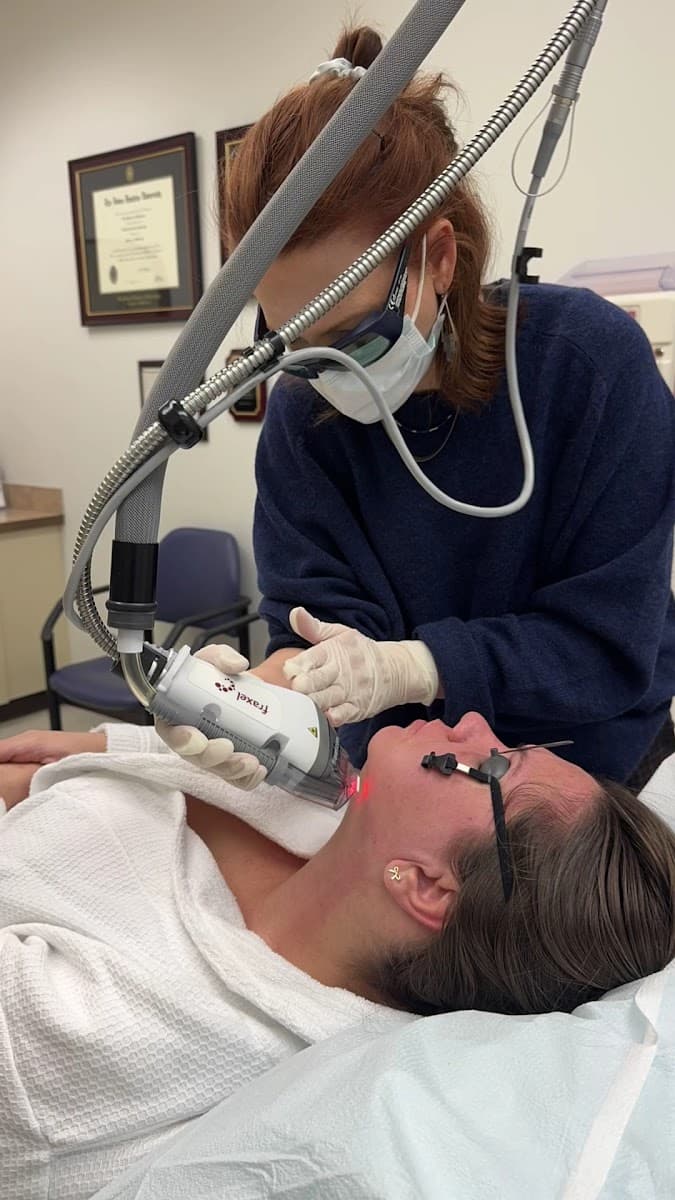
Ada West Dermatology
Meridian, ID
★★★★★4.9 (10,211)
Lift the mid-face. Restore a youthful contour.
Meridian, ID
Baton Rouge, LA

Glen Mills, PA
Atlanta, GA
Peoria, AZ

Hiram, GA

Rockville, MD
Wheaton, MD
Largo, FL

Surprise, AZ
Bellaire, TX

La Grange, IL
Columbia, SC
Lee's Summit, MO

Greensburg, PA


El Paso, TX
Snellville, GA

Sugar Land, TX

Las Cruces, NM

Palm Harbor, FL
Highlands Ranch, CO
Showing 24 of 10,223 clinics
Estimates are for educational purposes only. Actual pricing varies by clinic, geography, and treatment area. Consult a verified clinic for a personalized quote.
Cheek Filler is generally considered safe when performed by a trained, licensed provider. Common side effects include temporary bruising, swelling, or redness at the injection site. Serious complications are rare but possible. Always consult a board-certified provider and disclose your full medical history before treatment.
One millilitre of cheek filler gives a visible but subtle change: about half a syringe per side, enough to restore mild flatness or add a soft highlight along the cheekbone. It will not create a sculpted contour. Results are immediate, settle in 3 to 4 weeks, and last 12 to 24 months.
One millilitre is roughly a fifth of a teaspoon split across two cheeks, so honest before-and-afters at this volume show a refreshed, slightly lifted midface rather than a redesigned one. That is often exactly right. Many injectors deliberately start at 1 mL, let it settle for four weeks, and add more only if needed, because it is far easier to add filler than to dissolve an over-filled cheek. Patients with mild, early volume loss and good skin elasticity get the most from 1 mL. If you have significant age-related or weight-loss hollowing, 1 mL will underwhelm; expect 2 to 4 mL over one or two sessions. Photos showing dramatic change from a single millilitre are usually also showing different lighting or makeup.
One millilitre (one syringe) is enough for subtle enhancement in patients with mild volume loss, but most people restoring age-related midface volume need 2 to 4 mL. Split across both cheeks, 1 mL is only 0.5 mL per side, which is a conservative starting dose you can build on at four weeks.
"One syringe" means 1 mL of product, not one treatment. Whether it is enough depends entirely on your starting point. A 30-year-old wanting a hint of cheekbone definition may be well served by 1 mL; a 55-year-old with significant midface hollowing typically needs 2 to 4 mL, sometimes staged across two sessions. Placement changes the math: deep, supraperiosteal filler on the bone acts as a strut and lifts more per millilitre than product spread superficially, so a skilled injector achieves more with less. Staging is a feature, not a limitation. Building volume gradually produces more natural results and avoids the over-filled look. Ask your injector to show you what 1 mL versus 2 mL looks like on someone with anatomy similar to yours.
Cheekbone filler typically costs $1,000 to $3,000 per session in the US, at $700 to $1,300 per syringe. Most patients need 1 to 2 syringes per side, so a common total is $1,600 to $2,600. Results last 12 to 24 months, which works out to roughly $100 to $150 a month.
Cheekbone (malar) augmentation uses thicker, structural fillers, such as Juvederm Voluma XC, Restylane Lyft, Restylane Contour or RHA 4, which sit at the top of the per-syringe range because they are built to hold shape against bone. Voluma is typically $850 to $1,300 per syringe. Biostimulators are an alternative: Sculptra runs $800 to $1,500 per vial with 2 to 4 vials over 2 to 3 sessions, so $2,000 to $5,000 in total, but lasts 2 or more years. Manufacturer rewards programs shave 5 to 15 percent for regular patients. Voluma and Restylane Lyft are FDA-approved for cheek augmentation. Budget for maintenance rather than a one-off; this is a recurring expense every 1 to 2 years.
Cheek filler lasts 12 to 24 months for most patients. Juvederm Voluma XC is FDA-labeled for up to 24 months in the midface, Restylane Lyft and Contour last 12 to 18 months, Radiesse lasts 12 to 18 months, and Sculptra, a collagen stimulator, lasts 2 or more years.
Cheek filler outlasts lip filler because the midface moves far less, and mechanical movement speeds up the body's breakdown of hyaluronic acid. Your own metabolism matters too: patients who are very lean or exercise intensively tend to sit at the shorter end. So does placement, with deep filler on the bone generally outlasting product spread superficially. The wear-off is gradual over months rather than sudden, and cheeks do not collapse or end up worse than before. Many injectors recommend a smaller top-up before the previous treatment has fully gone, since the existing filler acts as a scaffold and less new product is needed. Sculptra and Radiesse leave behind some stimulated collagen even after the product itself has been absorbed.
One 1.5 mL syringe of Radiesse gives a subtle lift when split between both cheeks: enough for mild flattening, but most patients wanting visible midface structure need 2 syringes or more. Cheek use is off-label; Radiesse is FDA-approved for nasolabial folds, hands and jawline contour.
Radiesse syringes are 1.5 mL, larger than the standard 1 mL HA syringe, so one syringe delivers more product than the comparison suggests. Split across both cheeks, that is roughly 0.75 mL per side: a real but modest correction. It is a reasonable starting point if you have mild volume loss and want to see how you respond before committing to more. Significant midface hollowing typically needs 2-3 syringes. Radiesse is placed deep, on or near the bone, where its firmness provides structure; superficial placement risks visible nodules. Remember it cannot be dissolved, so starting conservatively and adding at a follow-up is the safer sequence. Results are visible immediately, improve over 2-3 months, and last 12-18 months.