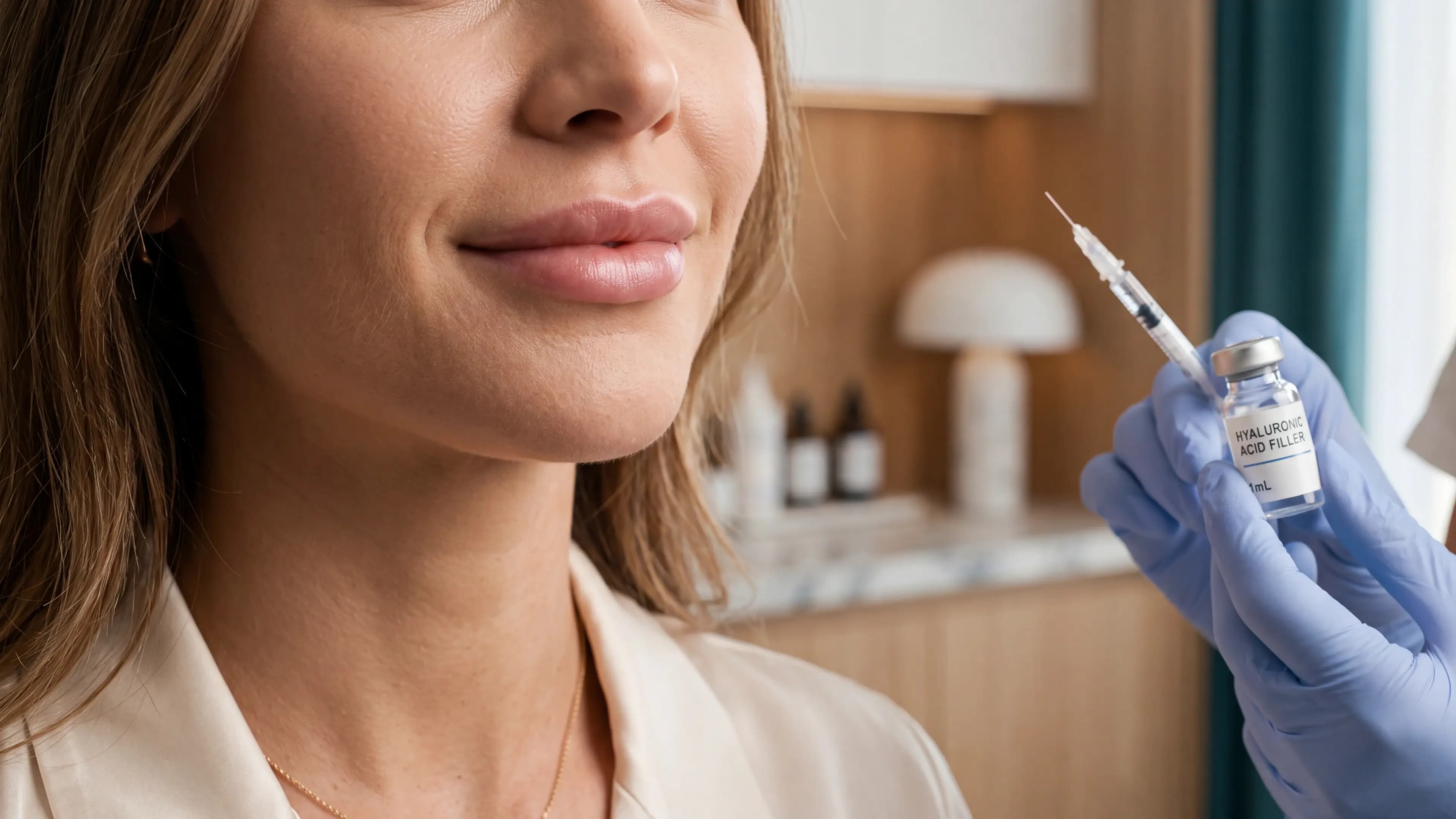
Lip filler is a hyaluronic acid gel injected into the lips to add volume, shape, and definition. Results appear immediately and are reversible with an enzyme. A treatment typically costs a few hundred to about a thousand dollars per syringe and lasts roughly 6 to 12 months, with brief swelling and bruising.
- Lip filler is hyaluronic acid gel: immediate volume and shape, and reversible with hyaluronidase.
- Several HA products (Juvederm, Restylane, RHA lines) are FDA-approved for lip augmentation in adults; some uses are off-label.
- Results last roughly 6 to 12 months; lips fade faster than cheeks because they move constantly.
- Cost is usually per syringe, commonly several hundred to about a thousand dollars, and recurs with maintenance.
- Common side effects (swelling, bruising) are mild and brief; vascular occlusion is rare but a medical emergency.
- Results and safety depend heavily on injector skill, so choose an experienced, licensed provider.
Lip filler is one of the most requested aesthetic injectables in the United States, but the marketing around it often outruns the facts. This guide explains what lip filler actually is, how hyaluronic acid works in the lip, which products the FDA has cleared for lip augmentation, what the procedure and recovery involve, how long results last, the real risks, the alternatives, and what drives the price. The goal is honest information you can act on, ending with a hand-off to a qualified injector near you.
*FDA status: Several hyaluronic acid fillers are FDA-approved for lip augmentation in adults (product-dependent age minimum, generally 21 or 22 and older). Other fillers and techniques are used off-label. This guide is educational and is not a substitute for medical advice.*
What lip filler is
Lip filler is a non-surgical cosmetic treatment in which a soft, gel-like dermal filler is injected into and around the lips to add volume, refine shape, sharpen the border, and improve balance. The overwhelming majority of lip fillers used today are made from hyaluronic acid, a sugar molecule that occurs naturally throughout the body, including in the skin, where it binds water and gives tissue its plumpness. Because the filler is a temporary implant rather than surgery, results are visible right away and gradually fade as the body breaks the material down.
It helps to be precise about the vocabulary. Lip filler is a type of dermal filler, and dermal fillers are regulated by the FDA as medical devices, not drugs. The lips are among the most-treated areas of the face because full, defined lips read as youthful and because subtle changes there strongly influence the overall look of the face. A skilled injector uses filler not only to make lips larger but to correct asymmetry, restore volume lost with age, soften fine vertical lip lines, and support the corners of the mouth. Done conservatively, the aim is balance, not size for its own sake.
How lip filler works
Hyaluronic acid works through a simple physical mechanism: it is a hydrophilic molecule, meaning it attracts and holds water. When a manufacturer cross-links hyaluronic acid into a stable gel and an injector places it in the lip tissue, that gel occupies space and draws in water, adding volume and cushioning the tissue. This is fundamentally different from a neuromodulator such as Botox, which relaxes muscle. Filler adds structure and volume; it does not change how the muscle moves. That distinction matters when you compare lip filler with a lip flip later in this guide.
Different products behave differently because manufacturers vary the concentration of hyaluronic acid, the degree of cross-linking, and the gel's firmness (its rheology). Softer, more flexible gels tend to integrate smoothly into the delicate, mobile lip and produce a natural feel, which is why several filler lines market a specific product for lips. Firmer gels are usually reserved for structural areas such as the cheeks or jawline. The lip is a demanding place to inject: it moves constantly, has a rich blood supply, and shows small errors easily, so product selection and placement technique are central to a good result.
Types of lip filler and FDA-approved products
Nearly all lip filler is hyaluronic acid, and within that category several products are specifically FDA-approved for lip augmentation. Well-known examples include Juvederm Ultra XC and Juvederm Volbella XC (Allergan/AbbVie), Restylane, Restylane Silk, and Restylane Kysse (Galderma), and the RHA collection (Revance). These differ in gel texture, lift, spread, and how long they tend to last, which is why an experienced injector chooses a product to match your anatomy and goals rather than using one filler for every patient.
Two other categories deserve honest mention. Permanent and semi-permanent fillers, such as silicone or calcium hydroxylapatite, are generally not appropriate for lips and are not FDA-approved for lip augmentation; they carry a higher risk of lasting complications in this mobile area. Fat transfer, which moves your own fat into the lips, is a surgical alternative rather than a filler. For most people seeking lip enhancement, an FDA-approved hyaluronic acid product is the standard of care because it is temporary, adjustable, and, importantly, reversible.
| Product family | Material | Notable lip products | Typical duration |
|---|---|---|---|
| Juvederm | Hyaluronic acid | Ultra XC, Volbella XC | ~6 to 12+ months |
| Restylane | Hyaluronic acid | Restylane, Silk, Kysse | ~6 to 12 months |
| RHA | Hyaluronic acid | RHA collection (resilient HA) | ~6 to 15 months |
| Fat transfer | Your own fat (surgical) | n/a (autologous) | Variable, can be long-lasting |
FDA approval and off-label use
The FDA regulates dermal fillers as medical devices and has approved specific hyaluronic acid fillers for lip augmentation in adults. The approval framework is product-by-product: a given filler is cleared for a defined use and age group (commonly 21 or 22 and older, depending on the product), based on the manufacturer's clinical data. That is why not every filler on the market is an approved lip filler, even though many are excellent for cheeks or folds.
Off-label use is common and legal in aesthetics, and it is not the same as unsafe. An off-label use means a licensed clinician is using an approved product for an indication or in a way the FDA has not formally cleared, based on clinical judgment and evidence. In the lips, an injector might use an approved filler that is technically labeled for another area, or blend techniques that fall outside the studied protocol. A trustworthy provider will tell you plainly which product is being used, whether that specific use is FDA-approved or off-label, and what the evidence looks like. Payment or promotion should never soften how a product's regulatory status is described to you.
Who is a good candidate
Good candidates for lip filler are generally healthy adults who want more volume, better definition, improved symmetry, or restoration of age-related lip thinning, and who have realistic expectations. The best results usually come from conservative, gradual enhancement that respects your natural proportions. Dermatologists specifically caution against overfilling: someone with very thin lips will look most natural with modest augmentation rather than a dramatic change in a single session.
Lip filler is not right for everyone. It is generally avoided during pregnancy and breastfeeding because it has not been studied in those groups. People with an active cold sore or oral infection should wait until it clears, and those with a history of frequent cold sores may be given antiviral medication because injections can trigger an outbreak. A known allergy to hyaluronic acid or to lidocaine (often mixed into the filler), certain autoimmune or connective-tissue conditions, bleeding disorders, or a history of severe reactions to previous filler all warrant a careful conversation with your injector. An honest candidacy screening, not a sales pitch, is the sign of a good provider.
What to expect during the procedure
A lip filler appointment starts with a consultation. Your injector examines your lips and lower face, discusses your goals, and recommends a product and an approximate amount, often starting with a single syringe or less. To manage discomfort, most providers apply a topical numbing cream, and many use fillers that already contain lidocaine; some also perform a dental-style nerve block for sensitive patients. The injection itself is quick. Most lip treatments take about 15 to 30 minutes and involve a series of small injections with a fine needle or a blunt-tipped cannula, with your injector shaping and massaging the lips as they work.
You will see added volume immediately, though the lips typically swell during and after the appointment, so the first-day appearance is not the final result. Many people can return to normal activities the same day. Your injector will usually ice the area to reduce swelling and give aftercare instructions: for roughly 24 to 48 hours, avoid firm pressure and friction on the lips, strenuous exercise, alcohol, and heat, and hold off on lip products. Swelling peaks in the first day or two, bruising can last a few days, and the final shape settles by about two weeks, which is the right time to assess results and decide on any small top-up.
Results, duration, and the evidence
Most hyaluronic acid lip filler lasts roughly 6 to 12 months, though ranges vary by source and product; Cleveland Clinic notes some patients see results persist longer, and metabolism plays a large role because a faster metabolism breaks the gel down more quickly. Lips tend to fade faster than structural areas such as the cheeks because they are in near-constant motion from talking and eating, which speeds the natural breakdown of the filler. Product choice, the amount placed, and your individual physiology all influence how long a given treatment holds.
The evidence base for hyaluronic acid lip augmentation is reasonably strong for a cosmetic procedure. A published meta-analysis concluded that hyaluronic acid is an effective dermal filler for lip augmentation, and multiple clinical case series report high patient satisfaction. That said, these are aesthetic outcomes measured largely by patient-reported satisfaction and clinician assessment, not long-term health endpoints, and results depend heavily on injector skill. No honest guide can promise a specific look or an exact duration for you. Plan for maintenance: many people schedule a touch-up once or twice a year to keep their result consistent, and because hyaluronic acid is reversible, an unsatisfactory result can usually be adjusted or dissolved.
Risks, side effects, and safety
The most common side effects are mild and short-lived: swelling, bruising, redness, tenderness, temporary lumpiness, and numbness that typically resolve within hours to a few days and can be managed with ice. Lumps or irregularities that persist can often be smoothed by your injector or dissolved. Because the lip has a rich blood supply, bruising is genuinely common, which is why injectors advise avoiding blood-thinning substances like alcohol and certain supplements beforehand when appropriate.
The serious risks are rare but real, and you should know them. The most important is vascular occlusion, which happens if filler is injected into or compresses a blood vessel and blocks blood flow. It requires urgent treatment, and warning signs include severe or disproportionate pain, blanching or dusky discoloration of the skin, and it is a medical emergency. Other uncommon complications include infection, allergic reaction, delayed-onset nodules or granulomas (a documented complication of lip augmentation reported in the medical literature), and cold-sore reactivation. The reassuring counterpoint for hyaluronic acid filler is reversibility: an enzyme called hyaluronidase can dissolve the product, which is used both to correct an unwanted result and, critically, as part of emergency management of vascular occlusion. Choosing a qualified, experienced injector who can recognize and treat complications is the single biggest factor in staying safe.
Alternatives to lip filler
Lip filler is not the only way to change the appearance of the lips, and the right option depends on your goal. A lip flip uses a small dose of a botulinum toxin (Botox and similar products) injected into the muscle along the upper lip so the edge rolls slightly outward, giving the illusion of a fuller upper lip without adding volume. It is subtle, temporary (usually a couple of months), and off-label, and it is best for someone who wants a hint of upper-lip show rather than genuine volume. Many people are choosing between a lip flip and filler; filler adds real volume and shape and lasts longer, while a lip flip is lighter, shorter-lived, and cheaper.
Other alternatives include fat transfer, a surgical procedure that relocates your own fat into the lips for a potentially longer-lasting result but with surgical downtime and less adjustability, and surgical lip lifts, which change lip proportion permanently. For people who mainly dislike fine vertical lip lines or dryness rather than volume, skincare, resurfacing, or a conservative filler approach may serve better. A candid provider will tell you when filler is not the best tool for what you actually want.
What lip filler costs and why prices vary
Lip filler is usually priced per syringe, and prices vary widely by region, provider experience, and product, so any single number is only a rough guide. In much of the United States a syringe commonly falls in the range of several hundred to around a thousand dollars, with premium or longer-lasting products at the higher end. Most people start with one syringe, and some achieve a subtle look with half a syringe. Because results are temporary, the cost recurs with each maintenance session, so it is fair to think of lip filler as an ongoing expense rather than a one-time purchase.
Several factors move the price. A highly experienced injector, such as a board-certified dermatologist or plastic surgeon, typically charges more than a newer provider, and that expertise correlates with safety and natural-looking results. Geography matters: major metros cost more than smaller markets. The specific product and the amount used also change the total. One honest caution: be wary of unusually cheap lip filler deals, which can signal an inexperienced injector, a diluted or non-approved product, or a setting without the training to manage a complication. With an injectable that carries a real, if rare, emergency risk, the cheapest option is rarely the smartest one.
Choosing a qualified injector
Because lip filler results and safety depend so heavily on who holds the needle, provider selection is the most important decision you will make. Look for a licensed medical professional with specific, extensive experience injecting lips, ideally a board-certified dermatologist, plastic surgeon, or a trained injector working under appropriate medical supervision. The American Academy of Dermatology emphasizes that your outcome depends largely on the experience of the person performing the procedure and that a conservative approach looks more natural.
Good questions to ask: What product are you using, and is it FDA-approved for lips? How many lip treatments do you perform? What happens if I get a lump, or in the rare event of a vascular occlusion, and do you keep hyaluronidase on hand? Can I see before-and-after photos of your own patients? A qualified injector will answer these plainly, screen your candidacy honestly, and set realistic expectations rather than pressure you toward a bigger result. When you are ready, injector.world can connect you with verified providers in your area so the conversation starts with someone qualified to treat you safely.
Frequently asked questions
What is the best age for lip filler?
There is no single best age. FDA-approved HA lip fillers are cleared for adults, typically 21 or 22 and older depending on the product. Younger patients often want subtle enhancement, while older patients seek restoration of age-related volume loss. Candidacy depends on health and goals, not age alone.
Is a lip flip or lip filler better?
They do different things. A lip flip uses botulinum toxin to roll the upper lip edge outward for a subtle look, lasting a couple of months and off-label. Filler adds real volume and shape and lasts 6 to 12 months. Filler is better for volume; a lip flip suits a light, subtle change.
What is the downside of lip fillers?
The main downsides are cost that recurs because results are temporary, a few days of swelling and bruising, occasional lumps, and a rare but serious vascular-occlusion risk that needs urgent care. Overfilling can look unnatural. The reassuring upside is that HA filler is reversible with hyaluronidase.
How soon after lip filler can I kiss or put pressure on my lips?
Avoid firm pressure, kissing, straws, and vigorous exercise for the first 24 to 48 hours so the filler settles evenly and swelling calms. Most people resume gentle normal activity within a couple of days. Always follow your injector's specific aftercare instructions.
Does lip filler hurt?
Discomfort is usually mild. Numbing cream, lidocaine mixed into most fillers, and sometimes a nerve block make the injections tolerable, and many people report pressure more than pain. Tenderness and swelling are normal for a day or two afterward.
- 1.Dermal Fillers (Soft Tissue Fillers) — U.S. Food and Drug Administration
- 2.FDA-Approved Dermal Fillers — U.S. Food and Drug Administration
- 3.Dermal Filler Do's and Don'ts for Wrinkles, Lips and More — U.S. Food and Drug Administration
- 4.Lip Fillers: What to Expect, Types, Benefits & Side Effects — Cleveland Clinic
- 5.Fillers: FAQs — American Academy of Dermatology
- 6.Hyaluronic Acid Is an Effective Dermal Filler for Lip Augmentation: A Meta-Analysis — PMC / U.S. National Library of Medicine
- 7.Delayed Granulomas as a Complication Secondary to Lip Augmentation with Dermal Fillers: A Systematic Review — PMC / U.S. National Library of Medicine