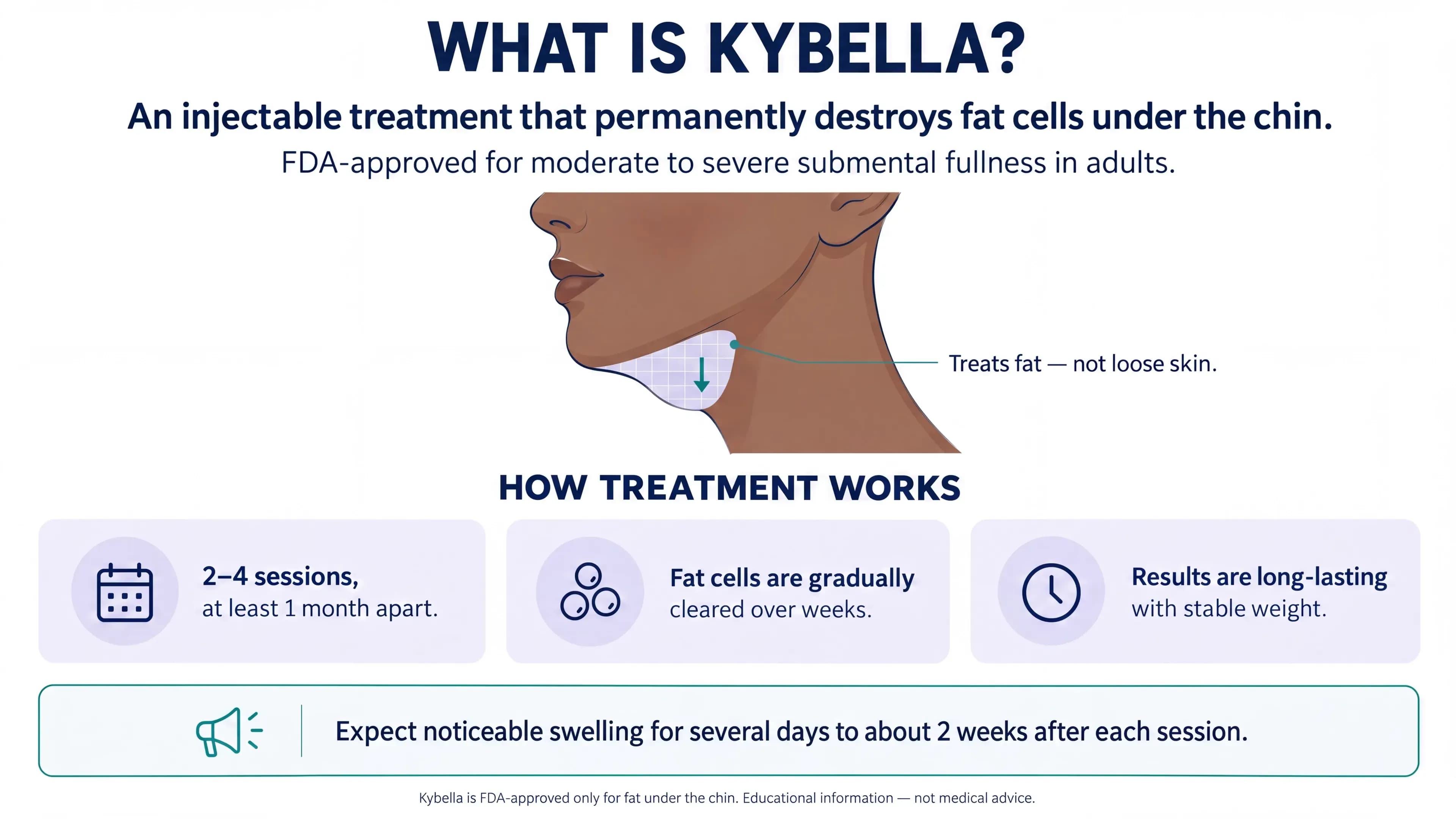
Kybella is an FDA-approved prescription injectable of synthetic deoxycholic acid that permanently destroys fat cells beneath the chin, reducing moderate to severe submental fullness (a double chin). It is given as a series of small injections across two to four sessions. It reduces fat, not loose skin.
- Kybella is injectable deoxycholic acid, a synthetic form of a bile acid the body already uses to break down fat.
- It is FDA-approved only for moderate to severe fat under the chin (submental fat) in adults; use in any other area is off-label.
- It destroys fat cells, which do not regenerate, so results are considered permanent once your goal is reached and your weight stays stable.
- Most people need 2 to 4 sessions at least a month apart (up to 6 permitted), with noticeable swelling for days to about 2 weeks after each.
- It treats fat, not loose skin, and it is not a weight-loss treatment; honest candidacy screening is essential.
- In phase 3 trials 70 percent of treated patients improved by at least one grade versus 18.6 percent on placebo, and 82.4 percent of responders held their result at 3 years.
- Main risks: swelling and bruising in most patients, plus an uncommon, usually temporary marginal mandibular nerve paresis (4.3 percent of trial subjects) and temporary swallowing difficulty.
Fullness under the chin, clinically called submental fat, is one of the most stubborn cosmetic concerns because it often has little to do with body weight. Genetics, aging, and the way each person stores fat can leave a pad beneath the jaw that survives dieting and exercise. For decades the only reliable way to remove it was surgery. Kybella changed that in 2015 with a nonsurgical, injectable way to reduce that one specific pocket of fat.
This guide covers what Kybella is, how deoxycholic acid destroys fat cells, what it can and cannot treat, who is a good candidate, what treatment and recovery feel like, what the clinical evidence shows and where its limits are, how it compares to CoolSculpting and surgery, and what drives the price. It is educational and is not a substitute for an in-person evaluation by a licensed medical provider.
FDA status stated plainly: Kybella (deoxycholic acid) is FDA-approved for improving the appearance of moderate to severe convexity or fullness associated with submental fat in adults. Injecting it anywhere else on the body is off-label. Off-label is not the same as unsafe, but it means the manufacturer has not proven that particular use to the FDA, and you deserve to be told which is which before you agree to treatment.
What Kybella is
Kybella is the brand name for a prescription injectable medication whose active ingredient is deoxycholic acid, a molecule your body already makes. In the digestive tract it works as a bile acid that helps break down and absorb dietary fat. The version in Kybella is a synthetic, non-animal-derived form manufactured to pharmaceutical purity, supplied as a clear sterile solution at 10 mg per milliliter in single-patient 2 mL vials. The U.S. Food and Drug Administration approved it in April 2015, and it is marketed by Allergan Aesthetics, an AbbVie company.
Which category of injectable it belongs to matters, because the aesthetics world files very different products under one heading. Kybella is not a neuromodulator like Botox, which temporarily relaxes muscles to soften wrinkles, and it is not a dermal filler like Juvederm or Restylane, which add volume beneath the skin. It is a cytolytic drug, also described as an injectable lipolytic or adipocytolytic agent. Its entire purpose is to subtract a small, targeted deposit of fat. It does not smooth expression lines, plump features, or lift and tighten skin.
It is delivered in a clinician's office as a set of tiny injections spaced across the treatment area in a grid pattern. Because the medication is prescription-only, it must be administered by a licensed medical professional or under appropriate medical supervision. That requirement is not a formality: the submental area is delicate, important nerves run nearby, and accurate placement of the product is the single largest factor separating a clean result from a complication.
How Kybella works
Kybella works through adipocytolysis, which simply means the destruction of fat cells. Injected directly into the fat layer under the chin, deoxycholic acid disrupts the membrane that holds each fat cell intact. The membrane fails, the cell is destroyed, and the body's normal cleanup machinery, driven largely by immune cells called macrophages, gradually clears the released lipid and cellular debris over the following weeks. Local tissue remodeling follows, which is part of why the contour keeps refining after each visit rather than changing overnight.
The clinically important consequence of that mechanism is durability. A mature fat cell that has been destroyed does not grow back and cannot store fat again. Once a course of Kybella has reduced the number of fat cells in the treated pocket, that reduction is expected to hold, provided your overall weight stays reasonably stable. This is a real difference from approaches that only shrink fat cells or that must be repeated indefinitely to maintain their effect.
The same mechanism explains both the recovery and the risk. The swelling most people notice under the chin is not just needle irritation; it is the visible signature of fat destruction and clearance in progress. And because deoxycholic acid acts on cell membranes generally, not only on fat cell membranes, product placed outside the fat layer can injure other tissue. Injecting into the correct plane, away from nerves, vessels, muscle, and salivary glands, is the whole safety game.
What Kybella treats, and what it does not
The FDA approval is narrow and specific. Kybella is indicated for the improvement in the appearance of moderate to severe convexity or fullness associated with submental fat in adults, meaning the fat pad sitting directly beneath the chin. Within that approved use it addresses fat, and only fat. That single sentence resolves most of the confusion people bring to a consultation.
Kybella does not treat loose or sagging skin, and it does not correct the platysmal banding that can also make a neck look heavy. If under-chin fullness comes mainly from skin that has lost elasticity rather than from fat, dissolving the fat underneath can occasionally make the looseness read as more obvious rather than less. It is also not a weight-loss treatment, and it is not intended for large volumes of fat, which surgery handles more efficiently. An honest provider separates fat from skin quality on examination and says so when Kybella is the wrong tool.
Some clinicians use Kybella off-label in other small fat pockets, such as jowls, along the jawline, bra-line fat, the flanks, the upper inner thighs, or above the knees. Those uses are not FDA-approved. Deoxycholic acid has been studied in several of those areas, but the evidence base is thinner than for the chin and the safety profile is less formally established. The FDA has separately warned that fat-dissolving injections which are not FDA-approved, including products bought online and self-injected, have been linked to permanent scarring, serious infection, skin deformity, cysts, and painful nodules.
Who is a good candidate
The strongest candidate for Kybella is a healthy adult bothered by a modest, well-defined pocket of fat under the chin, whose skin still has reasonable elasticity, and whose weight is stable or close to it. The pivotal trials enrolled adults with moderate to severe submental fullness and a body mass index at or below 40, a useful signal of the population in whom the drug was actually studied. Patients who fit that profile tend to need fewer vials and fewer sessions, which also makes treatment more economical.
You are less likely to do well if your fullness is driven mainly by skin laxity, if the volume of fat is large, if you want overall weight loss, or if your profile concern is really a small or receding chin, a structural issue that fat removal cannot fix. In those cases a skin-tightening device, a chin filler, liposuction, or a neck lift may be the honest recommendation instead.
Kybella is contraindicated when there is active infection at the injection sites. The prescribing information also directs caution in anyone with a current or prior history of swallowing difficulty, a group excluded from the clinical trials, because treatment may worsen the problem. Extra caution applies with a bleeding disorder or blood thinners, prior surgery or scarring in the submental area, and anatomy that makes safe placement difficult. Safety in pregnancy and breastfeeding has not been established. There is no single best age for Kybella: candidacy is decided by the ratio of fat to skin quality in your neck, although younger skin often retracts more readily once fat is removed.
The procedure: what to expect
A course begins with a consultation. The provider assesses how much submental fat is present and where it sits, judges skin elasticity, reviews your medical history and medications, rules out contraindications, and maps a realistic plan: vials per visit, number of visits, and how much change to expect. This is also the appointment where an experienced injector will tell you if Kybella is not your best option.
On treatment day the area under the chin is cleaned and marked, usually with a temporary grid or treatment template so injection points are spaced evenly. Topical numbing cream, ice, or an injected local anesthetic is commonly used. The product is then delivered as a series of small subcutaneous injections, typically 0.2 mL each, placed roughly one centimeter apart. A single session can involve up to 50 injections, to a maximum single-treatment dose of 100 mg, and the injecting itself usually takes only fifteen to twenty minutes.
Treatments are spaced at least one month apart, and most people need two to four sessions, though the labeling permits up to six. Swelling begins almost immediately and is expected: many people look fuller or firmer under the chin before they look slimmer, and it can last from several days to about two weeks after each session. Bruising is common, reported by the large majority of trial participants, along with pain, numbness, redness, and areas of firmness. Most people resume routine activity within a day, but it is sensible to schedule a first session well away from a wedding or major event.
Results, evidence, and how long they last
Results build gradually, because they depend on the body clearing destroyed fat cells over weeks rather than on an instant volume change. Most people first see a difference after the second session, with continued refinement as swelling settles, so the final contour is judged some weeks after the last visit rather than the day after it.
The evidence behind those claims is unusually well documented for an aesthetic injectable. In REFINE-1, a multicenter randomized double-blind placebo-controlled phase 3 trial, 70.0 percent of patients treated with deoxycholic acid achieved at least a one-grade improvement on paired clinician and patient rating scales, compared with 18.6 percent on placebo, and 13.4 percent achieved at least a two-grade improvement compared with none on placebo. MRI-verified fat reduction favored the drug by a wide margin, with 46.3 percent of treated patients meeting the imaging response criterion versus 5.3 percent. Treated patients also reported significantly better satisfaction and less psychological burden about their submental area.
Durability has been measured, not merely assumed. In a follow-up of the REFINE trials out to three years after the last treatment, 82.4 percent of treated responders maintained their response at year three, and 74 percent of patients who were satisfied at twelve weeks were still satisfied. No new treatment-related adverse events emerged over that period.
The limits are worth stating plainly. The improvement is real but usually modest: a one-grade change is a visible refinement, not a transformation, and only a minority achieved two grades. The trials were industry-sponsored and primary endpoints were assessed at twelve weeks. Significant weight gain can still enlarge the fat cells that remain and blunt the visible benefit, even though the destroyed cells are gone for good. No responsible provider should promise a guaranteed outcome.
Safety, side effects, and risks
Used within its approved indication by a trained injector, Kybella has an established safety record, but it is not risk-free. The most common effects are local and expected: swelling, bruising, pain, numbness, redness, and areas of firmness or small nodules under the chin. Bruising was reported by the large majority of treated participants in clinical trials, and moderate to severe pain was common but short-lived, with a median duration of about one day. These effects almost always resolve over days to a few weeks.
The more serious risks are less common but genuinely matter. The marginal mandibular nerve, which controls part of the smile, runs close to the treatment zone, and imprecise injection can bruise or irritate it. In REFINE-1, marginal mandibular nerve paresis was reported in 4.3 percent of treated subjects, about 1.0 percent of all treatment sessions. Cases were mostly mild, temporary, and resolved without lasting effects, but a lopsided smile for weeks is a meaningful thing to consent to. Difficulty swallowing has also occurred, generally alongside marked swelling and soreness, and in trials it resolved on its own with a median of about three days and a reported range of one to eighty-one days.
Less frequent reports include injection site ulceration, tissue damage when product is placed in the wrong plane, hair loss at injection sites, and injection site infection, which was added to the prescribing information in a later labeling update. Seek medical care promptly if you develop trouble swallowing or breathing, a facial droop, an open wound, spreading redness or fever, or symptoms that worsen rather than settle. The through-line across every one of these risks is the same: who holds the syringe is the variable you control, and it is the one that matters most.
Kybella compared with other double-chin options
The realistic alternatives for a double chin are CoolSculpting (cryolipolysis), submental liposuction, and a surgical neck lift, plus a chin filler when the underlying issue is projection rather than fat. Kybella and CoolSculpting are both nonsurgical and both permanently reduce fat cells, but they get there differently: Kybella uses a grid of injections and usually several sessions with conspicuous swelling, while CoolSculpting cools the fat through an applicator on the skin, generally with less downtime. Neither one tightens skin.
Liposuction and neck-lift surgery are more invasive but can do more. Liposuction removes a larger volume of fat in a single procedure, and a neck lift addresses skin laxity and muscle banding that no injectable can touch. Surgery delivers a bigger, faster change at the cost of anesthesia, downtime, a higher price, and surgical risk. For someone whose main problem is loose skin, an injectable that only removes fat is the wrong instrument regardless of how many sessions they buy.
One frequent mix-up is worth clearing up: Botox and Kybella are not interchangeable and do not compete, because Botox relaxes muscle and cannot reduce fat. The table below compares the main options on the attributes that actually drive the decision. Treat it as a starting point for a conversation with a qualified provider, not as a verdict, because the correct answer depends on your anatomy.
| Attribute | Kybella | CoolSculpting | Submental liposuction | Neck lift surgery |
|---|---|---|---|---|
| What it is | Injection of deoxycholic acid | Controlled fat cooling device | Surgical fat suction | Surgical lift of skin and muscle |
| Best for | Small, defined fat pocket | Small to moderate fat pocket | Larger fat volume | Fat plus loose skin and banding |
| Tightens skin | No | No | Minimal | Yes |
| Typical sessions | 2 to 4 (up to 6 permitted) | 1 to 2 per area | 1 | 1 |
| Downtime | Days to about 2 weeks of swelling | Minimal | Days to weeks | Weeks |
| Anesthesia | Topical or local | None | Local or general | General |
| Permanence | Permanent (fat cells destroyed) | Permanent (fat cells destroyed) | Permanent | Long-lasting |
| FDA status for the chin | FDA-approved for submental fat | FDA-cleared for submental fat | Established surgical procedure | Established surgical procedure |
Cost overview
Kybella is a cosmetic treatment, so insurance does not cover it and you pay out of pocket. It is priced per vial, and because most people need more than one vial per session and more than one session, the number that matters is the cost of a full course rather than the price of a first visit. Published national ranges commonly land around several hundred dollars per vial and roughly one to two thousand dollars per session for a typical two-vial treatment, putting a two to four session course in the low thousands. Those are educational ranges, not a quote, and they move substantially by market.
Several factors drive what you actually pay. The volume of fat being treated determines vials per session and sessions overall, and both multiply the total. Geography matters, with major metropolitan practices charging well above smaller markets. The injector's credentials and experience, the type of practice, and any consultation or facility fee all move the number. The only reliable price is a written estimate from your provider after an in-person assessment.
When you compare quotes, ask three questions: is this per vial or per session, how many vials do you anticipate, and what is the realistic total for my neck. Then weigh experience alongside price. An unusually cheap offer can mean an inexperienced injector, under-dosing that leads to extra sessions, or a product that is not genuine FDA-approved Kybella. The offsetting advantage is that a finished course is a one-time investment with no maintenance cost. For a fuller breakdown and current ranges, see the dedicated Kybella cost guide.
Choosing a provider and next steps
Choosing the injector is the most consequential decision you will make about Kybella, more consequential than the brand comparison or the price. Look for a licensed medical professional who treats the submental area regularly, who can describe the local anatomy including the marginal mandibular nerve without being prompted, and who can show you before-and-after photographs of their own patients with necks that resemble yours.
Good questions to ask at consultation: how much of my fullness is fat versus loose skin, how many vials and sessions do you expect, what will the swelling look like and how long will it last for someone with my anatomy, what is your experience with nerve-related complications and how do you manage them, and what would you recommend instead if Kybella is not my best option. A provider who is willing to talk you out of a treatment is showing you exactly the judgment you want holding the syringe.
Confirm as well that you are receiving genuine, FDA-approved Kybella rather than an unapproved fat-dissolving product, and that the plan is for the under-chin area unless you have knowingly agreed to an off-label use with the evidence limits explained. A thorough in-person consultation is the necessary next step: it is the only way to confirm your fullness is fat rather than skin, build a realistic session plan, and get an accurate quote. When you are ready, we can connect you with qualified, licensed injectors near you who offer Kybella.
Frequently asked questions
How much does Kybella cost?
Kybella is cosmetic, so you pay out of pocket, and it is priced per vial. Because most people need several vials across two to four sessions, the total varies widely with how much fat is treated, your region, and the injector. Published ranges are educational only; a written in-person quote is the only reliable number.
What are the downsides of Kybella?
The main downsides are conspicuous swelling under the chin for days to about two weeks after each session, bruising and tenderness, the need for multiple visits, and out-of-pocket cost. It also does nothing for loose skin. Less common risks include firm nodules and a temporary uneven smile from nerve irritation.
Is Kybella better than Botox?
They do completely different jobs, so neither is better. Botox relaxes muscles to soften wrinkles and cannot reduce fat. Kybella destroys fat cells under the chin and does nothing to expression lines. A provider may plan both for a neck and jawline, but they are not substitutes for one another.
What is a cheaper alternative to Kybella?
There is no cheap injectable shortcut. Depending on anatomy, submental liposuction can cost less per unit of fat removed for larger volumes, and weight loss may reduce fullness if the fat is weight-related. Avoid unapproved fat-dissolving injections sold online, which the FDA links to scarring, infection, and nodules.
What is the best age for Kybella?
There is no best age. Kybella is approved for adults, and candidacy depends on the ratio of fat to skin quality, not birth year. Younger skin often retracts better once fat is removed, but a provider should assess elasticity, fat volume, and weight stability individually before recommending treatment.
- 1.KYBELLA (deoxycholic acid) injection, for subcutaneous use: full prescribing information — U.S. Food and Drug Administration
- 2.Using Fat-Dissolving Injections That Are Not FDA Approved Can Be Harmful — U.S. Food and Drug Administration
- 3.REFINE-1, a Multicenter, Randomized, Double-Blind, Placebo-Controlled, Phase 3 Trial With ATX-101, an Injectable Drug for Submental Fat Reduction — Dermatologic Surgery (PubMed, PMID 26673433)
- 4.Reduction of unwanted submental fat with ATX-101 (deoxycholic acid), an adipocytolytic injectable treatment: results from a phase III, randomized, placebo-controlled study — British Journal of Dermatology (PubMed, PMID 24147933)
- 5.Improvements in Submental Contour up to 3 Years After ATX-101: Efficacy and Safety Follow-Up of the Phase 3 REFINE Trials — Aesthetic Surgery Journal (PubMed, PMID 33617632)
- 6.Kybella: nonsurgical treatment for fat below the chin — Atrium Health Wake Forest Baptist
- 7.What to Know About Kybella Injections — WebMD