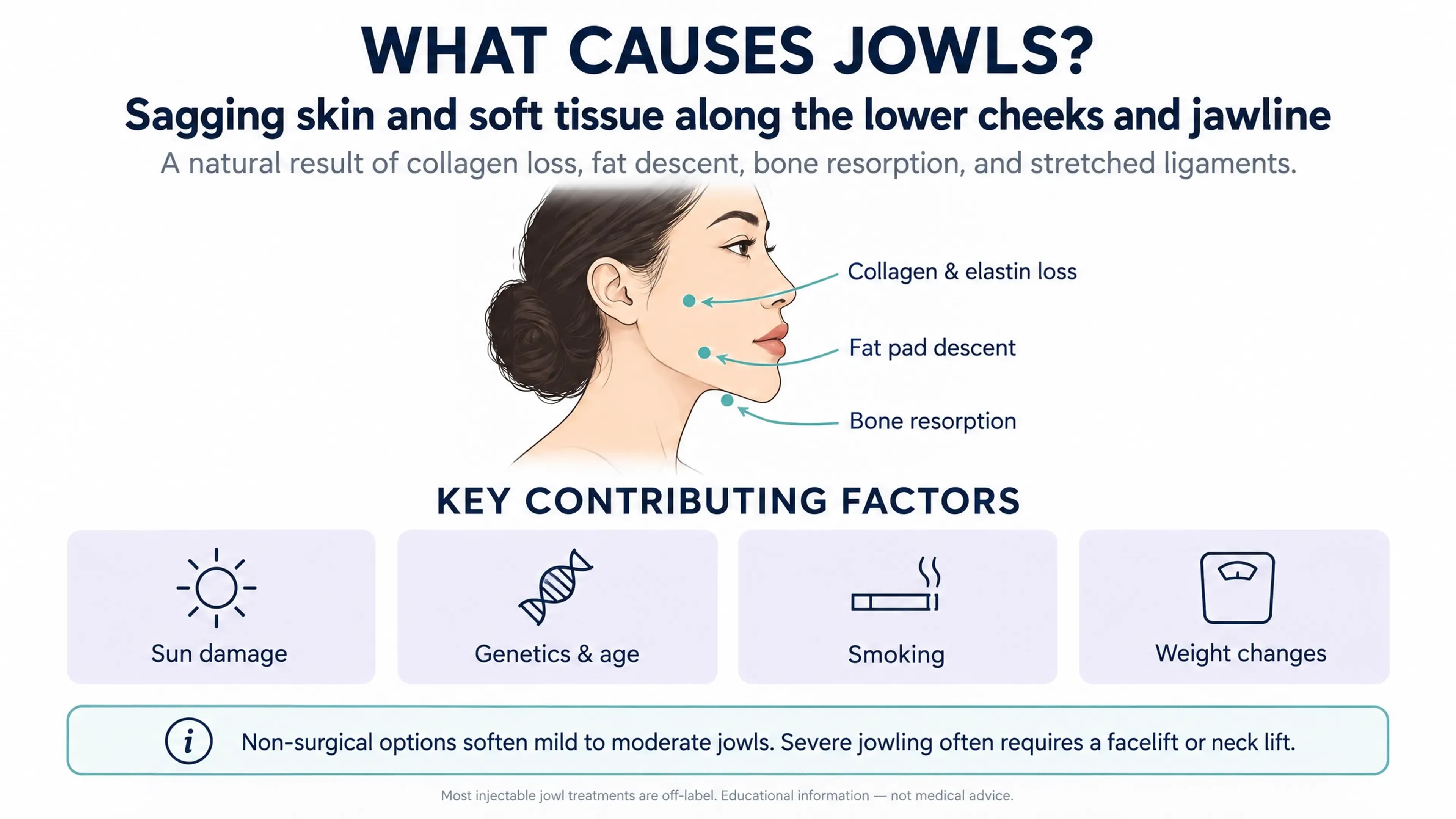
Jowls are sagging skin and soft tissue along the lower cheeks and jawline that blur the jaw's sharp border. They form as skin loses collagen and elastin, facial fat pads descend, and bone recedes with age. Sun damage, genetics, smoking, and weight changes accelerate them.
- Jowls are sagging skin and soft tissue along the lower cheeks and jawline; they are a normal appearance change, not a disease.
- The main cause is layered: collagen and elastin loss, deep fat pad deflation and descent, bone resorption, and stretched ligaments, sped up by sun, smoking, genetics, and weight changes.
- Sunscreen, not smoking, retinoids, and stable weight genuinely slow jowling but do not reverse it.
- Non-surgical options (cheek and jawline filler, Sculptra/Radiesse, Kybella, thread lifts, Ultherapy/RF microneedling) soften mild to moderate jowls; most are used off-label for this area.
- For moderate to severe jowls, a facelift or neck lift is the most effective and longest-lasting option.
- Provider skill matters more than brand: filler in the lower face carries a real vascular-occlusion risk, and Kybella sits near a nerve that controls the smile.
*FDA status: dermal fillers and biostimulators are FDA-approved for facial wrinkles and volume loss; using them specifically to lift jowls or define the jawline is common but often off-label. Kybella is FDA-approved only for fat under the chin, not for jowls. This guide is educational, not medical advice.*
What jowls are
Jowls are the loose skin and soft tissue that sag along the lower cheeks and jawline, blurring the once-sharp border between the face and the neck. In everyday cosmetic use the term describes drooping tissue below the corners of the mouth and along the jaw, making the lower face look heavier or more aged.
Jowls are a descriptive appearance change, not a disease, and they are usually harmless. Mild jowling is a normal part of facial aging that most people begin to notice from their 40s onward, though it can appear earlier. They tend to arrive alongside related lower-face changes such as marionette lines and a softened jaw contour, because the same underlying processes drive all of them. Treatment is a personal choice about appearance, not a medical necessity.
It helps to separate jowls from other jaw-area concerns. A double chin (submental fullness) is fat under the chin rather than sagging at the jaw edge; a poorly defined jawline can be caused by that fat, by a lightly built bone structure, or by early laxity rather than true jowls. Distinguishing which one you have matters, because the treatments differ. A clinician assessing jowls is really judging how much of the change is loose skin, how much is displaced fat, and how much is lost bony support underneath.
What causes jowls
Jowls form when the structures that hold the lower face taut weaken at several layers at once, so the main cause is rarely one thing. In the skin, collagen and elastin decline with age, a process accelerated by ultraviolet light, so the skin thins and loses its ability to spring back.
Beneath the skin, the face's fat compartments change: deep fat pads that provide support deflate, while superficial fat drifts downward, an anatomy mapped in detail by Rohrich and Pessa. The facial skeleton itself resorbs over time, particularly around the jaw and midface, removing the scaffold the soft tissue rests on. The retaining ligaments that tether skin to bone stretch, and gravity does the rest, letting tissue pool along the jawline.
Lifestyle and genetics set the pace. Sun exposure is the single biggest preventable driver of collagen breakdown, and smoking, poor sleep, and significant weight fluctuation all speed laxity. Rapid or large weight loss, including from GLP-1 medications, can leave excess skin that reads as jowls, sometimes called 'Ozempic face'. Repetitive downward pressure, such as constantly looking down at a phone, and simple family history also contribute. Jowls are therefore the visible sum of skin, fat, bone, and ligament change.
Who develops jowls and when
Most people see the first hints of jowling in their late 30s to 40s, with more definition through the 50s and 60s as collagen loss compounds. But jowls are not strictly age-gated. Some people notice slackness along the jaw in their 20s, usually because of genetics, significant weight change, or heavy early sun exposure.
Bone structure matters as much as age. Thin skin, a less-projected jaw, or a shorter chin give the overlying tissue less support, so even modest laxity can look like jowls in a younger person. Weight is a two-way factor: carrying extra facial fat can create fullness that later sags, while losing weight quickly can leave skin that no longer fits its frame, which is why jowls do not simply disappear after major weight loss and can even become more visible.
Genetics is the strongest predictor of how early and how prominently jowls appear, which is why they often run in families. If jowls appear suddenly, are markedly asymmetric, or come with other new facial changes, that is worth raising with a clinician rather than assuming it is ordinary aging.
How to prevent or slow jowls
You cannot stop facial aging, but you can slow the changes that create jowls, and starting early genuinely changes how the lower face ages over decades. Daily broad-spectrum sunscreen is the most evidence-backed step, because ultraviolet exposure is the largest preventable cause of collagen loss. Not smoking preserves collagen and the small blood vessels that feed the skin.
A topical retinoid, used consistently over months, thickens skin and supports collagen; vitamin C and other antioxidants add modest protection. Keeping weight stable avoids the stretch-and-deflate cycle that loosens skin. Good sleep, hydration, and a nutrient-adequate diet support overall skin quality.
So-called facial exercises or 'face yoga' are popular ways people try to fix jowls naturally, but the evidence that they lift jowls is weak, and aggressive pulling on the skin could in theory worsen laxity, so treat those claims with skepticism. Prevention will not reverse jowls that already exist, but for younger people worried about early jowling these no-procedure steps are the sensible first line.
Treatment options for jowls
Once jowls have formed, medspa (non-surgical) options can soften them but cannot match surgery for advanced sagging. The honest framing matters: most injectable approaches to jowls are used off-label, meaning the product is FDA-approved for facial wrinkles or volume loss generally, not for jowls specifically.
Cheek and jawline filler: hyaluronic acid filler placed in the mid-cheek restores deep support and can lift the jawline indirectly; placing filler along the jaw to sharpen it or camouflage the jowl is common but off-label, and firmer 'high G-prime' fillers are usually chosen for this area.
Biostimulators (Sculptra, Radiesse): these prompt the body to build its own collagen over months. Sculptra (poly-L-lactic acid) is FDA-approved for nasolabial folds and facial fat loss; Radiesse (calcium hydroxylapatite) is FDA-approved for facial folds. Using either to firm the jawline or jowl is generally off-label.
Kybella (deoxycholic acid): FDA-approved only to dissolve fat under the chin (submental fat). Injecting it into a fatty jowl is off-label and done cautiously, because the jowl sits near the marginal mandibular nerve that controls the smile.
Thread lifts (PDO threads): dissolvable barbed sutures give a modest, temporary mechanical lift plus some collagen stimulation. Results are subtle and short-lived compared with surgery.
Energy devices: microfocused ultrasound (Ultherapy) and radiofrequency microneedling (for example Morpheus8) tighten skin by heating deeper layers to stimulate collagen. Ultherapy is FDA-cleared to lift the eyebrow, under-chin, and neck; results are gradual and best for mild to moderate laxity.
Surgery, the reference standard (not a medspa service): a facelift or neck lift repositions and tightens deeper tissue and removes excess skin. For moderate to severe jowls it is the most effective and longest-lasting option and the benchmark other treatments are measured against.
| Underlying cause | Best-matched treatment |
|---|---|
| Skin laxity / collagen loss | Energy devices (Ultherapy, RF microneedling), topical retinoids |
| Deep fat deflation / lost support | Cheek filler, biostimulators (Sculptra, Radiesse) - often off-label for jowls |
| Excess or fatty jowl | Kybella (off-label), fat-reduction procedures |
| Sagging tissue needing a lift | Thread lift (mild, temporary); facelift or neck lift (moderate to severe) |
| Poorly defined jawline | Jawline filler (off-label, high G-prime) |
What results to expect
Non-surgical jowl treatments improve the appearance rather than erase it, and the degree depends on how much laxity you start with. Filler results appear over days to a couple of weeks; biostimulators build gradually over two to three months as collagen forms, and injectable results typically last from several months to about two years depending on the product and area.
Energy-device tightening is gradual, showing over roughly two to six months, and usually needs maintenance. Thread lifts give an immediate but subtle lift that fades within months to about a year. For mild early jowling these can be genuinely satisfying and enough to delay surgery. This tier of options is also what many people, including celebrities, use to soften a sagging jawline without an operation, alongside good skincare and, eventually, surgery.
For heavy, established jowls, expect softening and better contour, not the crisp jawline that only a facelift produces. Be wary of before-and-after images or 'non-surgical facelift' marketing that implies surgical results without surgery. A candid provider will tell you when your degree of sagging has outgrown what injectables and devices can deliver, which is a sign of trustworthy advice rather than a lost sale.
Risks and safety
Every injectable and device carries risk, and the lower face is an anatomically busy area. Common, temporary effects from fillers and biostimulators include swelling, bruising, tenderness, and small lumps. The serious risk with any filler is accidental injection into a blood vessel (vascular occlusion), which can cause skin loss or, rarely, vision problems, and is a medical emergency; this is why an experienced injector who knows facial vascular anatomy matters more than the brand of product.
Kybella near the jaw can injure the marginal mandibular nerve, causing a temporary, occasionally longer-lasting, uneven smile, along with swelling and possible skin injury if misplaced; published reviews specifically catalog adverse events from deoxycholic acid used in submental and jowl fat. Thread lifts can cause dimpling, thread extrusion, or infection. Energy devices can cause burns or, rarely, unwanted fat loss and nerve effects if overtreated.
Choosing a licensed, experienced medical provider and disclosing your full medical history and medications is the single most important safety step. Off-label use is legal and common, but it should be an informed choice you have discussed, with the risks and the evidence explained plainly before you agree.
Cost considerations
Costs vary widely by provider, city, the amount of product or number of sessions, and the specific brand, so treat any figure as a rough range only and expect an itemized quote at consultation. Injectable fillers and biostimulators are usually priced per syringe or per vial, and jowl or jawline correction often needs more than one, so a full course commonly runs into the low four figures.
Kybella is priced per vial and typically needs multiple vials across two or more sessions. Thread lifts and energy-device treatments such as Ultherapy or radiofrequency microneedling generally range from several hundred to a few thousand dollars per session, often with a recommended series. Because most non-surgical results are temporary, budget for maintenance every several months to a couple of years.
Surgery (a facelift or neck lift) is a much larger one-time cost but lasts far longer, which can make it more economical over time for significant jowls. All of these are cosmetic procedures, so insurance does not cover them. Ask what maintenance will cost, not just the first appointment, before committing.
When to see a provider
See a licensed, experienced injector or a board-certified dermatologist or plastic surgeon when jowls bother you enough to consider treatment, so you get an honest read on whether a non-surgical option will actually help or whether surgery is the better value for your degree of laxity. A good consultation examines your skin quality, fat, and bone structure, explains which options are on-label versus off-label for your case, and hands you a realistic plan rather than a hard sell.
Book sooner, and say so specifically, if jowling appears suddenly, is notably one-sided, or comes with other new facial changes, since ordinary jowls develop slowly and symmetrically. Bring your history: past cosmetic treatments, current medications and supplements (some raise bruising risk), autoimmune conditions, and any tendency to keloid scarring all change what is safe and sensible.
Ask direct questions at the consultation: how many jowl cases the provider treats, which option they recommend and why, what is on-label versus off-label for your case, and what results and maintenance are realistic. Because the lower face is high-risk for injectables, provider skill and credentials matter more than any single product or price, and a clinician who honestly says surgery would serve you better than injectables is giving you good advice. Use the link below to find a qualified injector near you and compare providers before you book.
Frequently asked questions
How can I tighten my jowls without surgery?
Non-surgical options include cheek and jawline filler for support, biostimulators like Sculptra or Radiesse to build collagen, energy devices such as Ultherapy or radiofrequency microneedling to tighten skin, and thread lifts for a subtle lift. Most are off-label for jowls and work best on mild to moderate laxity.
Do jowls go away after weight loss?
Usually not, and they can look worse. Losing weight reduces facial fat but does not restore skin elasticity, so skin that has stretched may sag more once the volume beneath it is gone. Rapid or large weight loss, including from GLP-1 medications, is a known trigger for loose lower-face skin.
What is the main cause of jowls?
There is no single cause. Jowls come from age-related collagen and elastin loss, deep facial fat pads deflating and superficial fat sliding downward, bone resorption in the jaw, and stretched retaining ligaments, all pulled by gravity. Sun damage, smoking, genetics, and weight changes speed the process.
What do celebrities do for sagging jowls?
There is no single celebrity secret. Typical approaches combine diligent sun protection and skincare, injectables such as cheek and jawline filler or biostimulators, skin-tightening energy devices, and, for more advanced sagging, a facelift or neck lift. Be skeptical of marketing that promises surgical results from a non-surgical treatment.
More common questions
What are the treatment options for jowls?
Jowls are treated with jawline and pre-jowl filler (2-4 syringes, 12-18 months), skin-tightening devices like Ultherapy, Sofwave, or Morpheus8, thread lifts, and (for genuinely loose skin) a lower facelift, which is the only option that removes it. Filler restores the jaw's border; it cannot lift sagging skin.
The right treatment depends on what's causing the jowl. Early jowling in someone with good skin elasticity is mostly volume loss and jawbone resorption, and 2-4 syringes of filler placed along the mandibular border and into the pre-jowl hollow gives real improvement for 12-18 months ($1,200-$4,000). When laxity dominates, radiofrequency or ultrasound tightening produces modest, gradual change over 3-6 months, lasting 12-24 months. Botox into the platysma can release some downward pull. When skin is truly loose, no injectable fixes it, and filler placed into the jowl itself, or in excess, adds weight and makes the jowl heavier. An honest provider will tell you when a facelift is the appropriate answer rather than selling more filler.
What non-surgical treatments work for jowls?
The non-surgical options are jawline and pre-jowl filler (2-4 syringes, 12-18 months), radiofrequency microneedling such as Morpheus8, ultrasound lifting such as Ultherapy or Sofwave, thread lifts, and platysma Botox. They soften early jowling by rebuilding the jaw border and tightening skin: none of them remove loose skin.
Jowls form from four things at once: the jawbone resorbing, the cheek fat pad descending, skin losing elasticity, and the platysma muscle pulling the lower face down. Filler addresses the first (it rebuilds the structural border of the jaw and fills the hollow in front of the jowl), but it lifts nothing. Energy devices give gradual, modest tightening that develops over 3-6 months and lasts 12-24 months. Threads provide mechanical lift for 12-18 months. A realistic expectation for early-to-moderate jowling is meaningful softening, not elimination. If the skin is genuinely loose, a lower facelift is the only treatment that removes it, and adding more filler to a lax lower face makes the jowl heavier, not lighter.
What happens during a non-surgical jowl procedure?
The most common non-surgical jowl procedure is jawline filler: consultation and photos, topical numbing for 10-20 minutes, then 2-4 syringes placed deep on the jawbone and into the pre-jowl hollow using a needle or cannula. It takes 15-45 minutes, needs no downtime, and settles by 3-4 weeks.
Expect swelling and possible bruising along the jaw for 5-10 days, plus firmness for a week or two: the jaw looks puffier than the final result at first. Aftercare: no strenuous exercise, alcohol, or heat for 24-48 hours, no facial massage for a week, and no dental work for 2-4 weeks. Alternatives involve different experiences: RF microneedling (numbing cream, 30-60 minutes, 2-5 days of redness, usually three sessions); Ultherapy or Sofwave (one session, no downtime, results over 3-6 months); thread lifts (local anesthetic, 30-60 minutes, several days of soreness). Because the facial and submental arteries run through this zone, call your provider immediately for white or mottled skin, or pain out of proportion.
Can you treat sagging jowls at home?
No at-home treatment lifts jowls. Facial exercises, gua sha, rollers, and creams cannot restore lost bone, fat, or skin elasticity. What home care can do is slow progression: daily broad-spectrum SPF, a topical retinoid, not smoking, and keeping weight stable. Visible jowling needs in-office treatment.
Jowls form from mandibular bone resorption, descent of the cheek fat pad, loss of collagen and elastin, and downward pull from the platysma muscle. None of those respond to surface treatment or muscle exercise. Retinoids and consistent sunscreen genuinely improve skin thickness and quality over months, which can make the jawline read slightly better, but the effect is modest and preventive rather than corrective. Evidence for facial exercise or "face yoga" reducing jowls is limited; it isn't harmful, but it shouldn't be expected to substitute for treatment. If jowling already bothers you, the options that actually work are jawline and pre-jowl filler, energy-based skin tightening, thread lifts, or (when skin is genuinely loose) a lower facelift.
What is the best treatment for jowls?
Jowls are treated by matching the fix to the cause. Lost volume and bone support respond to jawline and pre-jowl filler. Mild-to-moderate skin laxity responds to radiofrequency or ultrasound tightening. Genuinely loose skin needs a lower facelift, which is the only option that actually removes it.
Match the treatment to the stage. Early jowling with good elasticity (often 30s-40s): 2-4 syringes of filler along the mandibular border and pre-jowl hollow, sometimes with platysma Botox, lasting 12-18 months at $1,200-$4,000. Moderate laxity with thinning skin: RF microneedling or ultrasound lifting, developing over 3-6 months and lasting 12-24 months, often alongside filler. Advanced jowling with neck laxity and platysmal bands: a lower facelift or neck lift, with results measured in years. The most common mistake is filling a lax lower face: added volume in unsupported tissue makes the jowl heavier, not lighter. A good provider will tell you which category you're in, even when the answer is surgery.
- 1.Facial Fat Compartments: A Guide to Filler Placement (Rohrich, Pessa) — PMC / Plastic and Reconstructive Surgery
- 2.Facelift (Rhytidectomy): how surgery addresses jowls — Cleveland Clinic
- 3.Kybella Cosmetic Injection (off-label use for jowls) — Cleveland Clinic
- 4.Kybella (deoxycholic acid) - FDA-approved indication — Allergan Aesthetics (official Kybella site)
- 5.Management of Serious Adverse Events Following Deoxycholic Acid Injection for Submental and Jowl Fat Reduction — PMC / systematic review
- 6.Dermal Fillers overview — American Society of Plastic Surgeons
- 7.Neck Lift — American Society of Plastic Surgeons