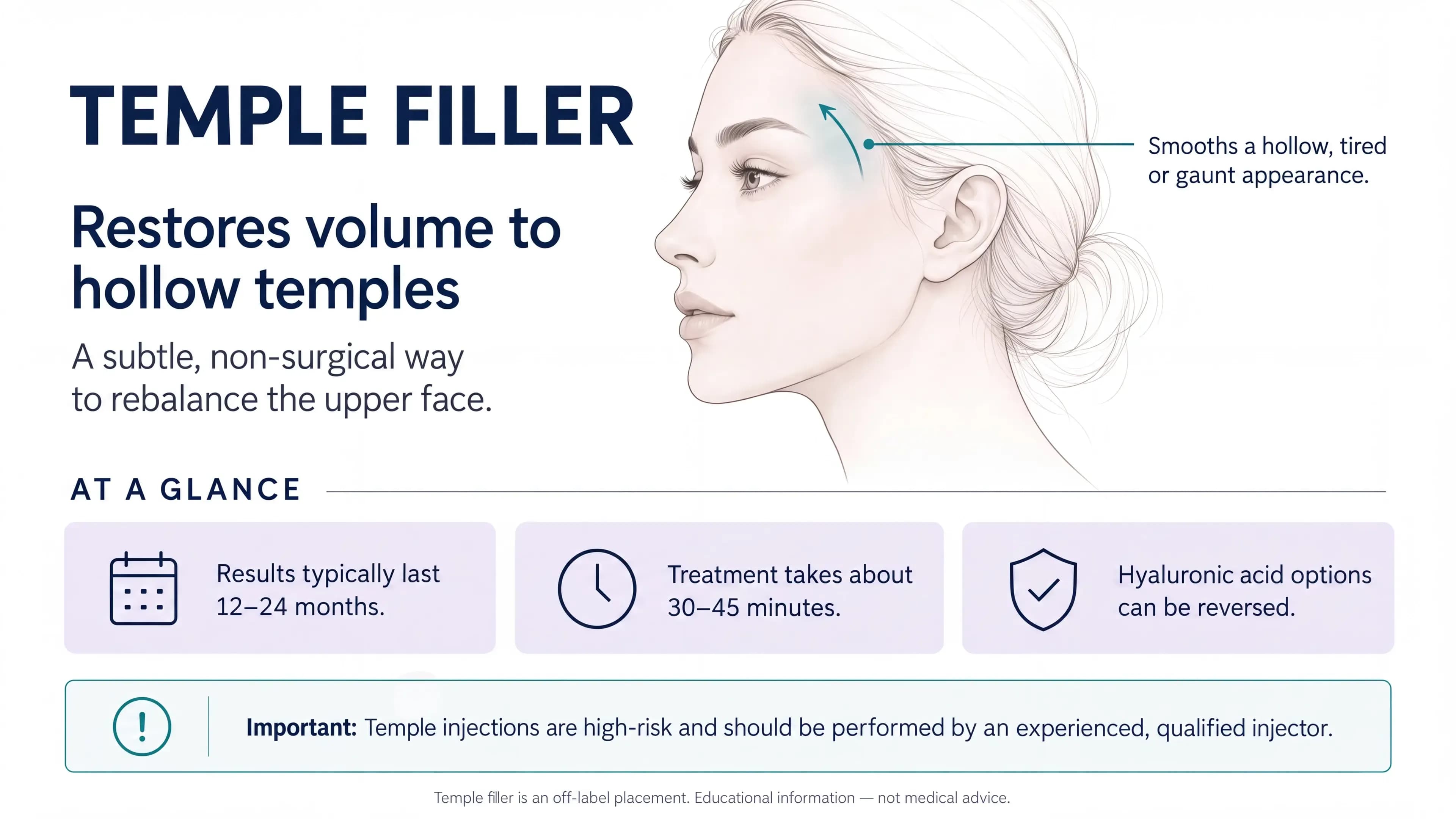
Temple filler is an off-label injectable treatment that uses hyaluronic acid or biostimulator fillers to restore volume in hollow, sunken temples. It softens a gaunt, tired look, rebalances the upper face, and can subtly lift the brow. Results typically last 12 to 24 months.
- Temple filler restores lost volume in the hollow at the side of the forehead, softening a gaunt or tired look and subtly lifting the outer brow.
- No filler is FDA-approved specifically for the temple; every option is an off-label placement of an approved product.
- Hyaluronic acid fillers (Juvederm Voluma, Restylane) are reversible with hyaluronidase; biostimulators (Sculptra, Radiesse) last longer but are not reversible.
- The temple is one of the highest-risk facial sites to inject because of its dense arteries, veins, and nerves; serious complications are rare but can be severe.
- Results typically last 12 to 24 months; treatment takes 30 to 45 minutes with little downtime.
- Provider skill is the single biggest safety factor: choose an injector who knows temporal anatomy and keeps hyaluronidase on hand.
The temples sit at the outer corners of the upper face, framing the eyes and brow. When they hollow with age or weight loss, the face can read as tired, gaunt, or older than it is, and the bony orbital rim becomes more visible. Temple filler is a quick, non-surgical way to rebuild that lost support. It is also, importantly, one of the higher-risk areas an injector can treat, because the temporal region is dense with arteries, veins, and nerves. This guide explains how the treatment works, who it suits, what it costs, and how to weigh the benefits against genuine safety concerns.
*FDA status: No dermal filler is specifically FDA-approved for the temple. Hyaluronic acid fillers such as Juvederm Voluma and Restylane Lyft are FDA-approved for cheek augmentation, and Radiesse and Sculptra are approved for other facial areas, so injecting any of them into the temple is an off-label use. Off-label does not mean unsafe or illegal; it means the manufacturer did not run trials for that specific site. This guide is educational and not a substitute for medical advice.*
What temple filler is
Temple filler is a non-surgical injectable treatment that places a soft-tissue filler into the hollow at the side of the forehead, between the eyebrow and the hairline, to restore volume that has been lost. The temple, or temporal fossa, is one of the first areas of the face to show volume loss, yet it is often overlooked because people focus on the cheeks, lips, and under-eyes. When a temple is full, the upper face has a smooth, gently convex curve from the brow to the hairline. When it hollows, that curve caves inward, the outer brow drops, and the bony ridge around the eye socket stands out, which the eye reads as fatigue or gauntness.
Filling the temple is corrective rather than purely decorative. By rebuilding the scaffold at the outer face, the treatment can restore a more heart-shaped, youthful facial outline, open up the eye area, and even improve how eyeglasses sit. It is frequently combined with cheek, brow, or under-eye treatment as part of a broader plan to rebalance the upper third of the face. Because the correction is subtle and structural, a well-treated temple usually looks like nothing was done at all: the face simply looks rested.
Why temples hollow and who is a candidate
Temporal hollowing has several drivers, and most people show a mix. Aging is the main one: the fat pads, muscle, and bone of the temple all shrink and shift over time, so the whole region deflates. Significant or rapid weight loss is another common cause, including the facial volume loss some people notice with GLP-1 medications, sometimes called Ozempic face. Genetics play a role, as some people simply have naturally recessed temples in their twenties, as does a naturally lean or athletic build with low body fat. Sun damage and smoking accelerate the collagen and fat loss that make the hollow deeper.
Good candidates are healthy adults with visible temporal hollowing who want a natural, non-surgical refresh and who understand the treatment is temporary. It suits people whose eyeglasses leave a visible gap over a sunken temple, people who look drawn after weight loss, and those seeking overall upper-face balance rather than one isolated wrinkle. Temple filler is not appropriate during pregnancy or breastfeeding, for anyone with an active skin infection at the site, or for people with a known allergy to a filler component such as lidocaine. A history of bleeding disorders, blood-thinning medication, or prior filler in the area should be disclosed, because these change the risk profile and the injection plan.
How temple filler works and which fillers are used
Two broad categories of filler are used in the temple, and they work differently. Hyaluronic acid (HA) fillers, such as Juvederm Voluma and Restylane Lyft or Contour, add volume immediately by binding water and physically occupying space. Their big advantage is reversibility: if a result is uneven or, more importantly, if filler compromises a blood vessel, the enzyme hyaluronidase can dissolve HA quickly. For a high-risk zone like the temple, many injectors favor HA precisely because it can be reversed in an emergency.
Biostimulatory fillers work by prompting the body to make its own collagen over weeks to months. Poly-L-lactic acid (Sculptra) and calcium hydroxylapatite (Radiesse) both fall in this group. They tend to give a gradual, natural build and can last longer, but they are not reversible with hyaluronidase, which raises the stakes if something goes wrong. The choice between them depends on your anatomy, your goals, and your injector's judgment. Whichever product is used, the injector reaches one of two depths: deep on the bone (supraperiosteal) using a needle, or in a defined interfascial plane using a blunt cannula. Both approaches aim to deposit filler away from the major vessels that make this region hazardous.
The following table summarizes the main filler options and their FDA status when used in the temple.
Filler options at a glance
| Filler type | Example brands | How it works | Typical duration | FDA status in the temple |
|---|---|---|---|---|
| Hyaluronic acid | Juvederm Voluma, Restylane Lyft, Restylane Contour | Adds volume instantly; reversible with hyaluronidase | 12 to 18 months | Off-label (approved for cheek, not temple) |
| Calcium hydroxylapatite | Radiesse | Adds volume and stimulates collagen; not reversible | 12 to 18 months | Off-label (approved for nasolabial folds and hands) |
| Poly-L-lactic acid | Sculptra | Stimulates gradual collagen over a series; not reversible | Up to 2 years or more | Off-label (approved for HIV lipoatrophy and cheek lines) |
No filler carries a temple-specific FDA approval, so every option in this table is an off-label placement of an approved product. A skilled injector will tell you which product they are using and why, and will explain the trade-off between the reversibility of HA and the longevity of biostimulators before you agree to treatment.
What to expect during the procedure
A temple filler appointment is short, usually 30 to 45 minutes including consultation. It begins with the injector assessing your facial proportions, marking the safe injection points, and cleansing the skin. Many providers apply a topical numbing cream, and most modern fillers also contain lidocaine, so discomfort is generally mild. The injection itself takes only minutes per side. Some injectors use a fine needle placed down to the bone at a single safe point; others prefer a blunt-tipped cannula introduced through one entry point, which can push vessels aside rather than piercing them and is often chosen specifically to lower vascular risk in this area.
During injection the provider works slowly, aspirating or using low pressure, and watches your skin closely for any sign of blanching, which can signal that a vessel is being compressed. You may feel pressure and hear a faint crunch if filler is placed on bone, which is normal. Afterward you can usually return to daily activities right away. Mild swelling, tenderness, redness, or small bruises at the entry point are common and typically settle within a few days to two weeks. Injectors generally advise avoiding heavy exercise, alcohol, and blood-thinning supplements for a day or two, and not massaging or applying firm pressure to the temples while the filler settles.
Results, duration, and the evidence
With hyaluronic acid, the volumizing effect is visible immediately, though the final look settles once initial swelling resolves over one to two weeks. Biostimulators like Sculptra build gradually and often require a short series of sessions spaced weeks apart, with the full collagen result appearing over two to three months. Most people see the temple hollow replaced by a smooth contour, a subtle lift at the outer brow and eye, and a more rested overall appearance. Because the correction is structural, results tend to look natural rather than obviously enhanced.
How long results last depends on the product, the amount used, your metabolism, and the area's movement. HA fillers in the temple commonly last 12 to 18 months, and biostimulators can last up to two years or longer. This is one reason the temple is considered a good-value area: the tissue moves relatively little compared with the lips, so filler tends to persist. It is worth being honest about the evidence base. Much of what is published on temple filler comes from anatomical studies, technique papers, and case series rather than large randomized trials, and reported durations vary between sources. Individual results differ, and no ethical provider can guarantee a specific outcome or lifespan for your filler.
Risks and safety in a high-risk zone
The temple deserves a frank safety discussion, because it is widely regarded among injectors as one of the riskiest areas on the face to fill. The temporal region contains the superficial temporal artery, the middle temporal vein (sometimes called the sentinel vein), deep temporal arteries, and the temporal branch of the facial nerve, all packed into a small space. This anatomy is why many clinicians rank the temple, along with the glabella and nose, among the highest-risk filler sites. Common, minor side effects include swelling, bruising, tenderness, redness, headache, and lumps or contour irregularities that usually resolve or can be smoothed.
The serious risks come from filler entering or compressing a blood vessel. Reported complications in the medical literature include vascular occlusion, skin necrosis (tissue death), localized hair loss, and, rarely, vision loss or stroke if material travels to vessels connected to the eye or brain. Non-thrombotic pulmonary embolism has also been described. These events are rare, but they are real and can be permanent, which is exactly why provider skill matters more here than almost anywhere else. Warning signs to seek immediate care for include severe or increasing pain, skin that turns white then dusky or mottled, vision changes, or one-sided weakness. This is also why reversible HA fillers are often preferred in the temple: if occlusion is suspected, hyaluronidase can be injected to dissolve the filler urgently. Choosing an injector who knows temporal anatomy, injects slowly, and keeps hyaluronidase and an emergency protocol on hand is the single biggest factor in staying safe.
Alternatives to temple filler
Dermal filler is not the only way to address hollow temples, and the best option depends on the cause and your goals. Fat transfer, or fat grafting, moves your own purified fat from another body area into the temple; it is more involved and surgical but can be long-lasting and uses your own tissue. Biostimulator injectables such as Sculptra, discussed above, sit between filler and surgery by rebuilding collagen for a gradual, durable result. For mild hollowing, some people combine energy-based skin tightening or good skincare and sun protection to slow further volume loss, though these do not replace lost volume.
For people whose main concern is the outer brow position rather than the hollow itself, a brow lift or a small amount of neuromodulator can raise the tail of the brow, but neither adds volume. Surgical options like temporal implants exist but are uncommon and carry the risks of any surgery. In practice, many injectors regard filler and fat transfer as the two main volume-restoring choices, with filler favored for its speed, lack of downtime, and, in the case of HA, reversibility. A thorough consultation should walk you through these alternatives rather than defaulting to filler because it is the quickest sale.
Cost and what affects it
Temple filler is generally priced by the syringe, and a typical treatment uses one to two syringes total to cover both sides. Because pricing varies widely by city, provider experience, and product, you should treat any figure as a range rather than a fixed price. In much of the United States a single syringe of hyaluronic acid filler commonly falls somewhere in the low-to-mid hundreds of dollars, so a full temple treatment often lands in the several-hundred to low-thousand dollar range depending on how many syringes are needed. Biostimulator treatments like Sculptra are usually sold as a series, which raises the total but can extend the result.
Several factors move the price. Product choice matters, as premium HA fillers and biostimulators cost more per syringe than basic products. Provider expertise is a major driver, and in a high-risk area like the temple, paying for a highly experienced, anatomically trained injector is a safety decision, not a luxury. Geography, clinic overhead, and the amount of correction you need all add up, and touch-ups or maintenance sessions over time are an ongoing cost to budget for. Be cautious of prices that seem far below the local norm, because deep discounts on a hazardous injection site can signal an inexperienced injector or a diluted or non-genuine product. The goal is a fair price for genuinely skilled hands, not the lowest number you can find.
Choosing a qualified provider
Given the anatomy involved, provider selection is the most important decision you will make about temple filler, more important than the brand of filler or the exact price. Look for a licensed medical professional, such as a board-certified dermatologist, plastic surgeon, or a trained nurse injector or physician assistant working under proper supervision, who performs temple injections regularly rather than occasionally. Ask how many temple treatments they do, whether they use a cannula or needle and why, and how they manage a suspected vascular occlusion. A confident, safety-minded injector will welcome these questions and will keep hyaluronidase on site.
A good consultation covers your goals, your medical history, the specific product and off-label nature of the treatment, realistic results, and the full list of risks including the rare serious ones. You should never feel pressured to decide on the spot or to add areas you did not come in for. Reviewing genuine before-and-after photos of the provider's own temple patients, not stock images, helps you judge their aesthetic and consistency. When you are ready to move forward, the safest next step is to compare qualified, vetted injectors near you and book a consultation with someone who treats this area routinely and can talk you through the trade-offs honestly.
Frequently asked questions
What does putting filler in temples do?
Temple filler rebuilds volume in the hollow at the side of the forehead. It smooths the sunken contour, reduces a gaunt or tired appearance, restores a more youthful upper-face outline, and can subtly lift the tail of the brow and open up the eye area.
Is temple filler high risk, and is it the riskiest place for fillers?
The temple is among the highest-risk facial areas to inject, alongside the glabella and nose, because it is dense with arteries, veins, and nerves. Serious complications like vascular occlusion are rare but possible, which is why an experienced, anatomically trained injector is essential.
How much does temple filler cost?
Temple filler is usually priced per syringe, and a treatment often uses one to two syringes. Costs vary widely by city, product, and provider, but a full treatment commonly ranges from several hundred to over a thousand dollars. Biostimulator series cost more overall.
Does temple filler go away?
Yes. Temple filler is temporary. Hyaluronic acid fillers typically last 12 to 18 months, and biostimulators like Sculptra can last up to two years or more before the body gradually absorbs the material and volume loss returns, at which point maintenance treatment is needed.
Can temple fillers go wrong?
They can. Minor issues like bruising or lumps are common and resolve. Rare but serious problems include vascular occlusion, skin necrosis, hair loss, and, very rarely, vision loss. Reversible hyaluronic acid and a skilled injector who keeps hyaluronidase on hand greatly reduce the danger.
- 1.Dermal Fillers (Soft Tissue Fillers) — U.S. Food and Drug Administration
- 2.FDA-Approved Dermal Fillers — U.S. Food and Drug Administration
- 3.An Expert Guide to Anatomy-Based Filler Injection for the Temple: Techniques and Clinical Insights — PMC / U.S. National Library of Medicine
- 4.Treacherous territory: Temple fillers and tissue necrosis — PMC / U.S. National Library of Medicine
- 5.Leveraging anatomy to improve safety and efficacy in temple augmentations: a case series of 20 patients — PMC / U.S. National Library of Medicine
- 6.JUVEDERM Voluma XC: Official Product Information — AbbVie / Allergan Aesthetics
- 7.Temple Filler: What to Know — Healthline