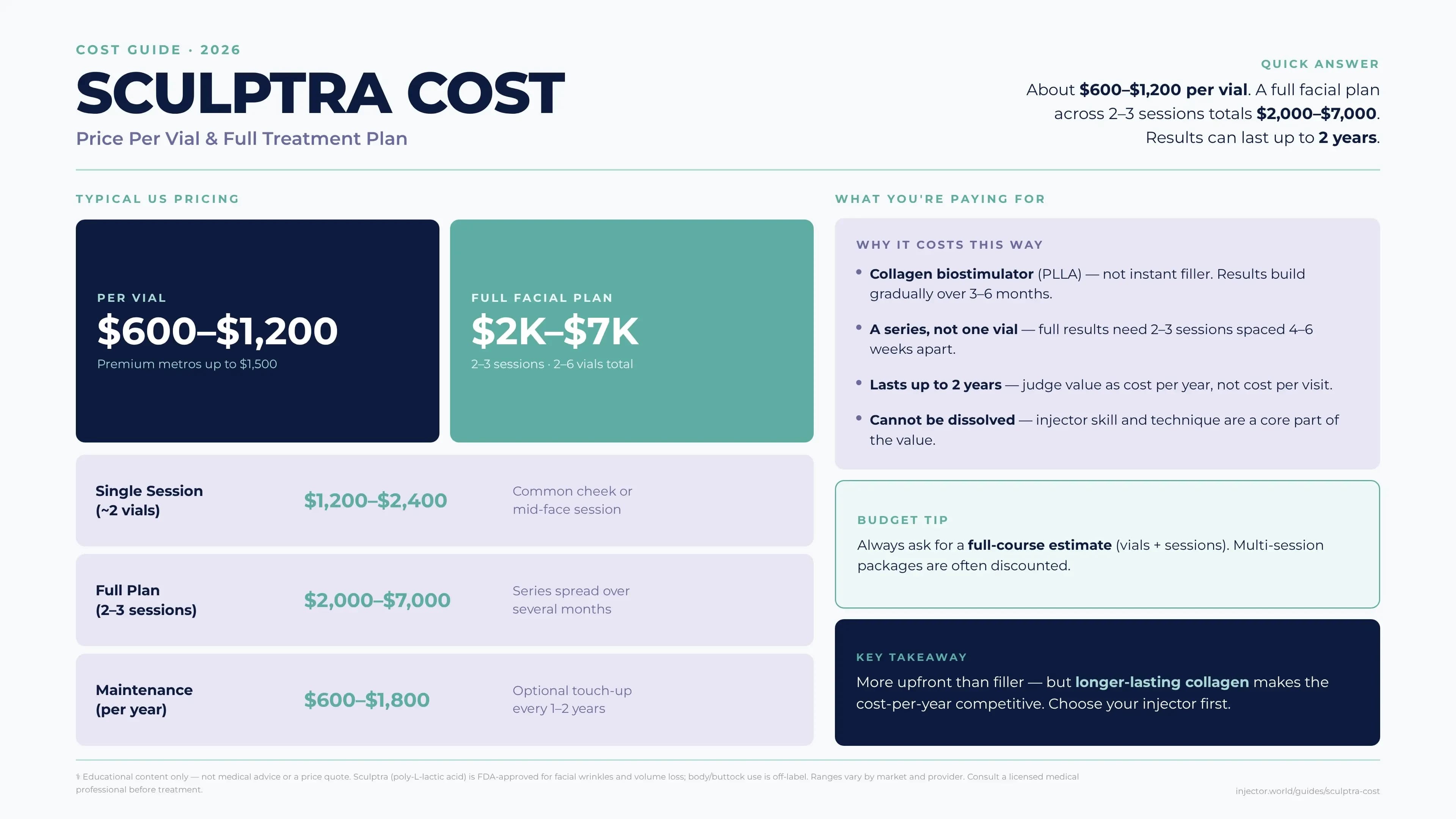
Sculptra typically costs about $600 to $1,200 per vial in the US. Because it is a collagen biostimulator applied in a series, most facial plans use several vials across 2 to 3 sessions and total roughly $2,000 to $7,000. Prices vary by provider, region, and vials needed.
- Sculptra is priced per vial, about $600 to $1,200; premium metros can reach $1,300 to $1,500.
- It is a collagen biostimulator, not an instant filler, so a full result needs several vials across 2 to 3 sessions.
- A single 2-vial session runs about $1,200 to $2,400; a full facial plan commonly totals $2,000 to $7,000.
- Results build gradually over months and can last up to 2 years or more, so judge value on cost per year.
- FDA-approved for facial wrinkles and volume loss; buttock and body augmentation are off-label.
- Sculptra cannot be dissolved, so an experienced, technique-focused injector is a core part of the value.
Ranges only. Actual price depends on the number of vials used, your market, and your provider. This guide is education, not a quote.
Prices below are national ranges compiled from provider price lists and patient-review reporting, not offers. FDA status is stated plainly throughout. Sculptra, generic name poly-L-lactic acid, is FDA-approved to correct facial wrinkles and age-related volume loss; buttock and body augmentation are off-label. Results build gradually over months rather than instantly, which is central to understanding what you are paying for. Confirm cost and candidacy with a licensed provider before deciding.
How much Sculptra typically costs
Sculptra is priced per vial. Across US clinics, a single vial commonly runs about $600 to $1,200, with many practices clustering around $800 to $950. Higher-cost metros such as New York, Los Angeles, and San Francisco can push $1,300 to $1,500 per vial, while some med spas advertise promotional pricing near $499 a vial. Treat any single number as a starting point, not a final bill.
The figure that actually matters is the full-plan cost, because Sculptra is rarely a one-vial treatment. A typical single mid-face or cheek session uses about 2 vials, or roughly $1,200 to $2,400. A complete facial restoration usually needs 2 to 6 vials spread over 2 to 3 sessions, so most people spend somewhere between $2,000 and $7,000 for a first course. Larger areas, more advanced volume loss, and premium markets sit at the top of that range.
No honest guide can quote your exact price online, because vial count is set by your anatomy, your degree of volume loss, and how much correction you want. Two people the same age can need very different amounts. The per-vial and per-plan ranges here let you sanity-check a quote and spot pricing that looks suspiciously low, but only an in-person assessment produces a real total.
| Cost item | Typical range* | Notes |
|---|---|---|
| Per vial | $600 to $1,200 | Premium metros can reach $1,300 to $1,500 |
| Single session (about 2 vials) | $1,200 to $2,400 | Common cheek or mid-face session |
| Full facial plan (2 to 3 sessions) | $2,000 to $7,000 | Most people need a series over several months |
| Maintenance (per year) | $600 to $1,800 | Optional touch-up, often every 1 to 2 years |
*Ranges only, compiled from provider price lists and patient-review reporting. Actual price depends on vials used, your market, and provider. Not a quote.
What you are paying for with Sculptra
Sculptra is not a traditional filler, and understanding that difference explains the cost structure. A hyaluronic acid filler physically adds volume the moment it is injected and is broken down by the body over months. Sculptra is a biostimulator made of poly-L-lactic acid, tiny particles that prompt your own skin to gradually produce new collagen. You are paying for a biological process, not an instant plumping gel.
Because the effect is gradual, a full result is built in layers. The product is injected across a session, the material is absorbed over weeks, and collagen rebuilds over roughly 3 to 6 months. That is why treatment is delivered as a series, most often 2 to 3 sessions spaced about 4 to 6 weeks apart, with each session adding to the foundation. Every vial and every visit in that series carries its own cost, which is why the full-plan number is higher than a single filler syringe.
You are also paying for injector skill and time. Sculptra requires careful reconstitution, correct dilution, even placement across a broad area, and specific post-treatment massage instructions. Because it is more technique-sensitive than most fillers, an experienced injector is a meaningful part of the value, not an upsell. The vial is only one input; the expertise that places it well is what turns product into a natural, long-lasting result.
What affects the price of Sculptra
The single biggest cost driver is the number of vials you need. More extensive volume loss, larger treatment areas, and a request for a fuller correction all mean more product. Someone with early, subtle hollowing in the cheeks may need only 2 vials total, while a person restoring significant age-related volume across the mid-face, temples, and jawline may need 4 to 6 or more over the course.
The number of sessions follows from that. A short course of 2 sessions costs less than a fuller 3-session plan, and some patients return for a maintenance vial every 1 to 2 years, which adds an ongoing but modest line item, roughly $600 to $1,800 a year depending on how much they use.
Provider credentials and location move the price too. Board-certified dermatologists and plastic surgeons, and highly experienced nurse injectors, often charge at the upper end, and with a technique-sensitive product that premium frequently shows in the result. Big metropolitan markets cost more than smaller cities for the same treatment. Finally, packaging matters: many clinics discount multi-vial or multi-session plans, so ask how a practice prices a full course rather than fixating on the headline per-vial figure.
How Sculptra compares on cost
Per vial, Sculptra costs about the same as a single syringe of hyaluronic acid filler, roughly $600 to $1,200. The difference is in how much you use and how long it lasts. Sculptra usually requires more vials and more sessions upfront, so the initial outlay is higher than starting with one or two syringes of filler. Over time, though, the comparison narrows: hyaluronic acid results typically last 6 to 18 months, while Sculptra can last up to 2 years or more, so the cost per year can be competitive with repeated filler visits.
Compared with surgical options such as fat transfer or a facelift, Sculptra is far less expensive upfront and involves no operating room, anesthesia, or downtime, but it also delivers subtler, more gradual change and does not lift significant sagging. It sits in the middle of the market: more of a commitment than a single filler syringe, far less than surgery.
The honest takeaway is that Sculptra is not the cheapest way to look refreshed today, but it can be a reasonable value for people who want gradual, natural volume that holds for a couple of years. If your goal is a quick, reversible touch-up, filler may cost less to start; if you want durable collagen restoration and can wait months for results, Sculptra often earns its place.
Sculptra results and longevity: why timing shapes value
Cost only makes sense alongside how long the result lasts, and Sculptra is a slow, durable investment. Because it works by stimulating collagen, you will not see the finished result on the day of treatment. Visible improvement typically appears over 6 to 12 weeks and continues building across the full series, reaching its peak a few months after the last session. Patients expecting instant gratification sometimes feel they overpaid early on, then reassess once the collagen matures.
Longevity is the payoff for that patience. Sculptra results commonly last up to 2 years, and some people see effects beyond that, which is longer than most hyaluronic acid fillers. The result fades gradually as the newly built collagen naturally turns over, rather than disappearing abruptly. This is why value is best judged as cost per year rather than cost per visit: a $3,000 plan that holds for two years is roughly $1,500 a year, which can compare favorably with maintaining filler every 9 to 12 months.
This timeline also affects candidacy, and therefore spend. Sculptra suits adults with mild to moderate volume loss and early laxity, commonly people in their late 30s through 60s. Younger patients may not need biostimulation yet, and very advanced sagging often responds better to surgery, so paying for Sculptra in those cases can mean paying for a result it cannot fully deliver.
Weighing risks against the cost
Part of judging whether Sculptra is worth its price is understanding what can go wrong, because complications carry their own cost in corrective visits and stress. The most discussed risk is the formation of small nodules or papules, firm bumps under the skin, which historically were linked to improper dilution, uneven placement, or inadequate post-treatment massage. Modern protocols, higher dilution volumes, and skilled injection have substantially reduced but not eliminated this risk.
Common, short-lived side effects include redness, swelling, tenderness, and bruising at the injection sites, which usually settle within days. As with any injectable, there is a small risk of infection and, rarely, vascular complications if product is placed incorrectly. Unlike hyaluronic acid fillers, Sculptra cannot be dissolved, so an uneven or overfilled result is corrected by time and management rather than a quick reversal. That irreversibility is a real reason some clinicians are cautious and a real reason to prioritize an experienced injector.
None of this makes Sculptra unsafe in appropriate hands; it makes the choice of provider a core part of the value equation. Paying a little more for a board-certified or highly experienced injector who follows current protocols is usually cheaper than paying to fix a poor result, and far cheaper in peace of mind.
How to budget for a full plan and find a qualified provider
Budget for a course, not a vial. When you request pricing, ask the clinic to estimate the likely total number of vials and sessions for your goals, the price per vial, and whether they discount a multi-session package. A quote for one vial tells you very little about what the finished result will cost. Build in the possibility of an occasional maintenance vial every year or two so the ongoing number does not surprise you.
Be wary of pricing that looks too good. Very low per-vial specials can signal over-dilution, an inexperienced injector, or pressure to buy more vials than you need. Because Sculptra is technique-sensitive and not reversible, the cheapest chair is rarely the best value. Compare providers on credentials, before-and-after photos of real patients, how clearly they explain the series and the timeline, and how honestly they discuss risks and off-label uses.
Choose a licensed, experienced injector, a board-certified dermatologist or plastic surgeon or a trained nurse injector working under medical supervision, and have a proper in-person consultation before paying. That visit is where an honest total replaces an online estimate. When you are ready to compare qualified providers and get a real assessment near you, use the provider hand-off below to find an injector who offers Sculptra in your area.
Frequently asked questions
How much do 2 vials of Sculptra cost?
Two vials commonly cost about $1,200 to $2,400 in the US, based on a per-vial range of roughly $600 to $1,200. Higher-cost metros can run more. Two vials is a typical single-session amount for the cheeks or temples, but a full plan usually needs more over several visits.
Is 2 vials of Sculptra enough?
For a single session targeting the cheeks or temples, 2 vials is common. Full-face collagen restoration usually needs more overall, often 2 to 6 vials total across 2 to 3 sessions. Older skin or greater volume loss may need more. Your injector maps vial count to your anatomy, not a fixed number.
Why do some plastic surgeons dislike Sculptra?
Some clinicians are cautious because Sculptra is technique-sensitive: improper dilution, placement, or massage historically raised the risk of nodules or bumps. Results are delayed and, unlike hyaluronic acid filler, not instantly reversible. In experienced hands with modern protocols these risks are lower, but injector skill matters a great deal.
Does insurance cover Sculptra?
No. Cosmetic Sculptra for facial volume or wrinkles is elective and not covered by insurance. Its original FDA approval was for HIV-related facial fat loss, which may rarely be covered, but aesthetic use is paid out of pocket. Ask providers about package pricing for a multi-session plan instead.
- 1.FDA Premarket Approval (PMA) - Sculptra / Sculptra Aesthetic (poly-L-lactic acid), P030050. — U.S. Food and Drug Administration
- 2.Sculptra Aesthetic - official manufacturer information (Galderma). — Galderma / Sculptra USA
- 3.Dermal Fillers - overview and average cost guidance. — American Society of Plastic Surgeons
- 4.Dermal Fillers - types, uses, risks, and what to expect. — Cleveland Clinic
- 5.Sculptra: what it is, cost, longevity, and how it works. — Healthline