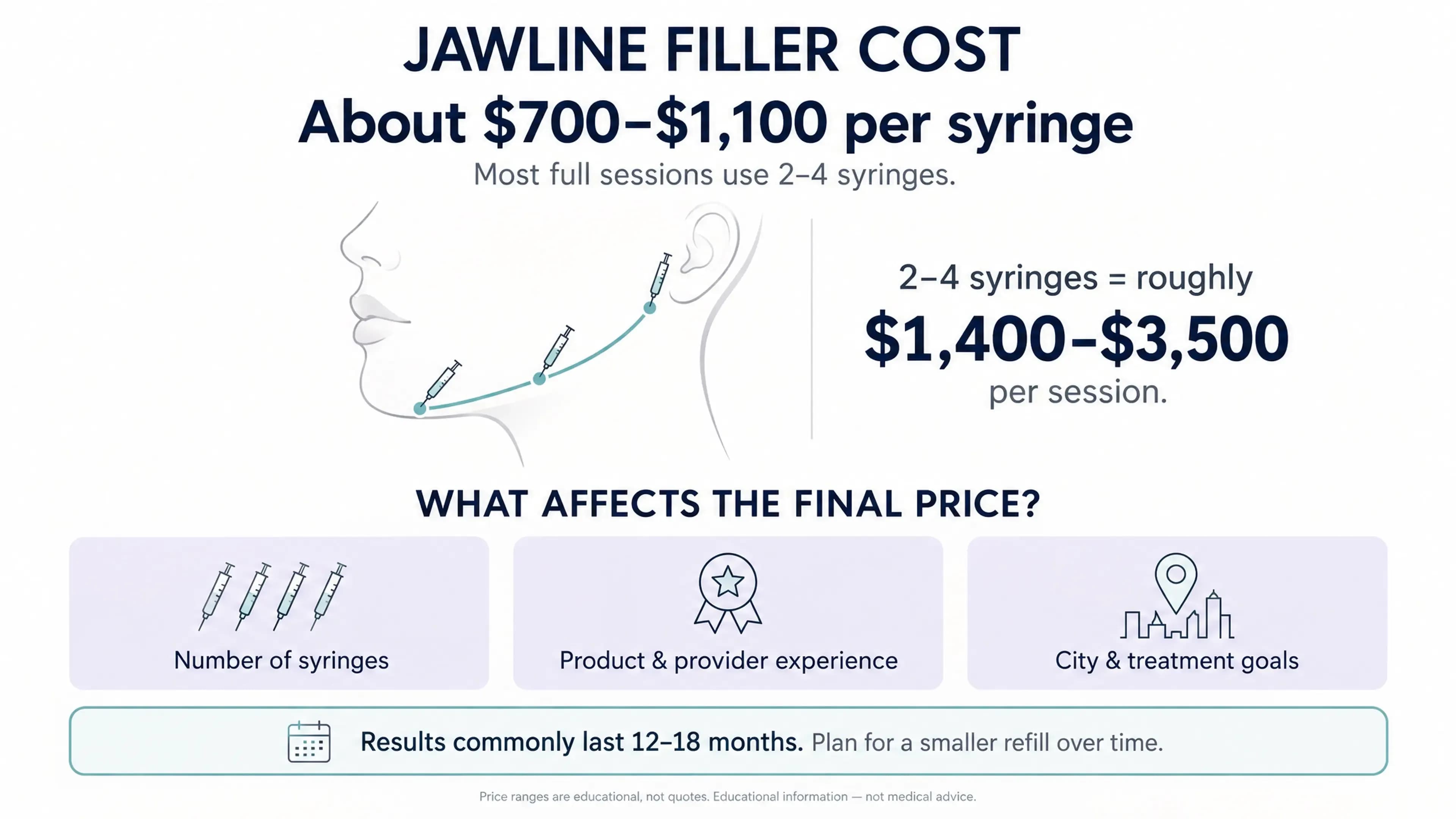
Jawline filler typically costs about $700 to $1,100 per syringe, and most people need two to four syringes, so a full session usually runs roughly $1,400 to $3,500. Final price depends on the product, your anatomy, your injector's experience, and your city. Ranges are educational, not quotes.
- Jawline filler typically costs about $700 to $1,100 per syringe; premium injectors or metros can reach $1,300 to $1,500.
- Most people need 2 to 4 syringes, so a full session usually runs roughly $1,400 to $3,500, and $1,500 to $4,000+ for extensive sculpting.
- Cost drivers: syringes needed, product chosen, injector credentials, and your city.
- Results last about 12 to 18 months; budget for a smaller refill roughly every 12 to 18 months.
- Juvederm Volux XC is FDA-approved for jawline definition; Voluma, Restylane Lyft, and Radiesse are used off-label for the jawline.
- Typical cost by structural filler (per syringe, national ranges, not quotes): Juvederm Volux XC (FDA-approved for jawline) $800 to $1,200; Juvederm Voluma XC (off-label) $800 to $1,200; Restylane Lyft (off-label) $650 to $1,000; Radiesse (off-label) $700 to $1,050.
Jawline filler is one of the most requested nonsurgical contouring treatments, and the first question most people ask is what it will actually cost. The honest answer is that the price is built from parts: the product itself, the number of syringes your anatomy needs, the training of the person injecting, and the market you live in. This guide breaks those parts down so you can read any quote you are given and understand whether it is fair, rather than just cheap or expensive.
Throughout this page, every figure is a national range for education, not a quote or an offer. Nobody can price your jawline accurately without seeing your face, discussing your goals, and confirming how much product it will take to reach them. A trustworthy provider gives you a written estimate after an in-person assessment, not a flat number over the phone. Treat any single advertised price with healthy caution, and use the ranges here to sanity-check it.
One more framing point before the numbers: with jawline filler, the injector matters more than the brand on the box. A structural result along the jaw depends on precise placement on or near bone in an area rich with blood vessels. Paying a little more for an experienced injector who doses conservatively and knows the anatomy is usually the better value, because a well-placed treatment lasts longer and carries less risk than a bargain that has to be corrected.
How much jawline filler typically costs
Jawline filler in the United States generally costs about $700 to $1,100 per syringe for the structural hyaluronic acid products used to sculpt the jaw, such as Juvederm Volux XC, Juvederm Voluma XC, Restylane Lyft, and Radiesse. In higher-cost metros or with in-demand injectors, a single syringe can reach $1,300 to $1,500. Because the jawline is a large area that runs from the chin back toward each ear, most people need more than one syringe to see a defined result.
Most patients use two to four syringes for a full jawline, so a typical session lands in the range of roughly $1,400 to $3,500. More extensive sculpting, or treatment that also addresses the chin at the same time, is commonly quoted at $1,500 to $4,000 or more. A conservative first session for someone who mainly wants a little more definition might use one to two syringes and cost closer to $700 to $2,200. Your injector should tell you the expected syringe count before you agree to anything.
These figures line up with what large directories and clinics report, but they move with time and place. Use them as a reality check, then ask for a written, per-syringe estimate tied to your plan.
What you are paying for in the price
A jawline filler price is not just the cost of a gel in a syringe. A meaningful share of what you pay covers the injector's time, skill, and judgment. Sculpting a jawline means placing product at precise depths, often on or close to bone, to create a crisp border without an overfilled or heavy look. That expertise is the single biggest driver of whether your result looks natural, and it is a large part of why an experienced injector charges more than a discount clinic.
The product itself is a real cost. Structural fillers designed for the jaw and chin, like Juvederm Volux XC, are firmer and more expensive to the clinic than thinner fillers made for fine lines, and that wholesale cost is passed through to you. You are also paying for the consultation, mapping and assessment of your facial proportions, sterile technique, and the aftercare and follow-up that a good practice provides. Many clinics fold a touch-up visit into the price, which has real value.
Finally, part of the price reflects safety infrastructure: a licensed medical setting, an injector trained to recognize and manage complications, and hyaluronidase on hand to dissolve hyaluronic acid filler if a vascular problem occurs. That readiness is not optional for a high-risk area like the jaw, and it is one reason the cheapest option is rarely the safest.
Factors that affect the cost of jawline filler
Several variables move your final price, and understanding them helps you compare quotes fairly. The number of syringes is the biggest one: a subtle refinement may need one to two syringes, while a strong, angular jawline or a jaw that has lost volume with age can take four or more. Because filler is usually priced per syringe, more product simply means a higher total. A good injector recommends the smallest amount that reaches your goal, not the most they can sell.
The product you choose matters too. FDA-approved, jawline-specific fillers such as Juvederm Volux XC often sit at the top of the range because they are engineered for structure and longevity. The injector's credentials and demand shift price as much as anything: a board-certified dermatologist or plastic surgeon, or a highly experienced nurse injector, commands more than a new provider, and it usually shows in the result. Geography is the last major lever, with large coastal metros costing noticeably more than smaller markets for the same work.
Watch for pricing that looks too good. A jawline treatment advertised far below these ranges can signal an overdiluted product, an inexperienced injector, or a non-medical setting. Promotions and manufacturer loyalty rewards, like Allergan's Allē program, can lower your cost legitimately, so it is fair to ask whether any are available.
How jawline filler compares on cost
Compared with other ways to sharpen the lower face, filler sits in the middle on price and low on downtime. Kybella, an injectable that permanently destroys fat under the chin, is FDA-approved only for submental fullness, not for building the jawline, and typically runs $1,200 to $1,800 per treatment across two to four sessions. It addresses a double chin rather than adding definition, so it solves a different problem than structural jawline filler.
Surgical options cost far more but last far longer. Neck liposuction commonly runs several thousand dollars, and a lower facelift or neck lift often costs $8,000 to $20,000 or more with anesthesia and facility fees, plus real recovery time. Filler is a fraction of that up front and requires no downtime, which is much of its appeal, but it is temporary and must be repeated, so the lifetime cost narrows the gap over many years.
Among fillers, brand differences are smaller than the marketing suggests. Volux, Voluma, Lyft, and Radiesse occupy overlapping price bands, and for most people the injector's skill and the total volume used matter more to the final look and cost than which structural brand is chosen. A candid provider will tell you when two products would give you a comparable result.
How long results last and the cost of upkeep
Value depends heavily on longevity, because filler is not permanent. Jawline results from hyaluronic acid fillers commonly last about 12 to 18 months, and firmer structural products like Volux are studied to maintain jawline definition for up to around 18 months in many patients. Radiesse, a calcium-based filler, tends to last roughly 12 to 15 months. Individual results vary with metabolism, product, placement, and how much movement the area sees.
To keep a defined jawline, most people budget for a touch-up or partial refill every 12 to 18 months. That maintenance visit often uses less product than the first session, since it tops up what has softened rather than rebuilding from scratch, so it usually costs less than the initial treatment. Over several years, a realistic plan is an initial session plus a smaller refill roughly once a year to once every year and a half.
Thinking in annual terms helps you judge value. A treatment that looks good and holds for 18 months can be a better deal than a cheaper one that fades in six months and needs redoing. When you compare quotes, ask how long the specific product is expected to last for your placement, not just the price today.
Weighing value: is jawline filler worth it
Whether jawline filler is worth the cost comes down to your goals and your candidacy. For someone with good skin quality who wants more definition along an existing jaw, or who has lost a little sharpness with age, filler can deliver a natural, noticeable improvement with no downtime, and many people find that a strong value. The best results come from realistic expectations: filler adds structure and definition, it does not create a dramatically new bone structure.
Fillers are less effective, and less worth the money, when the real issue is significant skin laxity or heavy jowls. Fillers can lightly camouflage early jowling by restoring support along the jaw, but they cannot lift moderate to severe sagging, and chasing that goal with more and more product gets expensive and can look overfilled. If loose skin is the main concern, energy-based skin tightening or a surgical lift may be the more honest, and ultimately more cost-effective, path, and a good provider will say so.
Value also depends on choosing the right injector the first time. Correcting a poorly placed or overfilled jawline, sometimes by dissolving it with hyaluronidase and starting over, adds cost and hassle. Paying for skilled, conservative work up front is usually the more economical choice across the life of the treatment.
Risks and safety considerations that affect value
The jawline and lower face are considered higher-risk areas for filler because they sit near important blood vessels, notably the facial artery. The most serious complication of any filler is vascular occlusion, where product blocks or compresses a vessel, which can cause skin death or, very rarely, vision loss if it affects vessels connected to the eye. Areas often cited as riskiest for filler include the region around the nose, the glabella between the brows, and the under-eye, but the jawline still demands careful, anatomy-aware placement.
Common, milder side effects are expected and temporary: swelling, bruising, tenderness, and firmness at the injection sites, usually settling within one to two weeks. Lumps or asymmetry can occur and are often correctable. Jawline filler is generally described as mildly to moderately uncomfortable rather than very painful, and most injectors use numbing cream and filler premixed with lidocaine, plus a blunt cannula in some cases, to keep it tolerable.
Safety is part of the value calculation. A key advantage of hyaluronic acid fillers is that they can be dissolved with hyaluronidase if there is a problem, which is why choosing a licensed medical injector who keeps it on hand matters. That safety margin is worth paying for, and it is a reason not to choose a jawline provider on price alone.
How to budget and find a qualified provider
To budget realistically, plan for a session rather than a single syringe. If most jawlines take two to four syringes at $700 to $1,100 each, a sensible planning figure is roughly $1,400 to $3,500 for a first treatment, plus a smaller refill every 12 to 18 months. Ask the clinic for a written, per-syringe price, confirm which product they will use, and get the expected syringe count in writing after your consultation. Beware quotes that are dramatically lower than these ranges.
When you compare providers, prioritize credentials and experience over the lowest price. Look for a board-certified dermatologist or plastic surgeon, or an experienced, licensed injector working under medical supervision, who treats the jawline regularly, shows real before-and-after photos of their own patients, and can explain how they manage complications. A good consultation includes an honest conversation about whether filler, skin tightening, or surgery best fits your face, even if that means less product sold.
Do not choose on price alone, and do not book a high-risk area with a discount pop-up clinic. The difference between a natural, lasting jawline and an expensive correction usually comes down to who holds the syringe. When you are ready, compare qualified injectors near you and ask each for a written estimate before you commit.
Frequently asked questions
How long do jawline fillers last?
Jawline results from hyaluronic acid fillers commonly last about 12 to 18 months, with firmer structural products like Juvederm Volux studied to hold definition toward the longer end. Radiesse tends to last roughly 12 to 15 months. Longevity varies with product, placement, and metabolism, so most people plan a refill every 12 to 18 months.
How many syringes of jawline filler do I need?
Most people use two to four syringes for a full jawline, though a subtle refinement may need one to two and a strong, angular result can take four or more. Because filler is priced per syringe, the count drives your total cost. Your injector should confirm the amount after assessing your anatomy and goals.
Can fillers fix sagging jowls?
Fillers can lightly camouflage early jowling by restoring support along the jawline, but they cannot lift moderate to severe sagging. If loose skin is the main issue, skin tightening or a surgical lift is usually more effective and more cost-effective. A good provider will tell you honestly whether filler suits your case.
How painful is jawline filler?
Most people find jawline filler mildly to moderately uncomfortable rather than very painful. Injectors typically use numbing cream and filler premixed with lidocaine, and sometimes a blunt cannula, to keep it tolerable. Temporary swelling, tenderness, and bruising afterward are common and usually settle within one to two weeks.
Where is the riskiest place for fillers?
Areas often cited as highest-risk include the region around the nose, the glabella between the brows, and the under-eye, because a vascular blockage there can, rarely, threaten skin or vision. The jawline is also a higher-risk area given nearby vessels, so choose a licensed medical injector who keeps hyaluronidase on hand.
- 1.Dermal Fillers (Soft Tissue Fillers): what they are and FDA-approved uses. — U.S. Food and Drug Administration
- 2.Dermal fillers: overview, safety, and what to expect. — American Academy of Dermatology
- 3.Dermal fillers: procedure, results, and average cost. — American Society of Plastic Surgeons
- 4.Kybella (deoxycholic acid) injection: FDA-approved for submental fat. — U.S. Food and Drug Administration
- 5.Hyaluronic acid fillers for lower face and jawline contouring: efficacy and duration. — PubMed Central (National Library of Medicine)
- 6.Soft-tissue filler complications and management of vascular occlusion. — PubMed Central (National Library of Medicine)