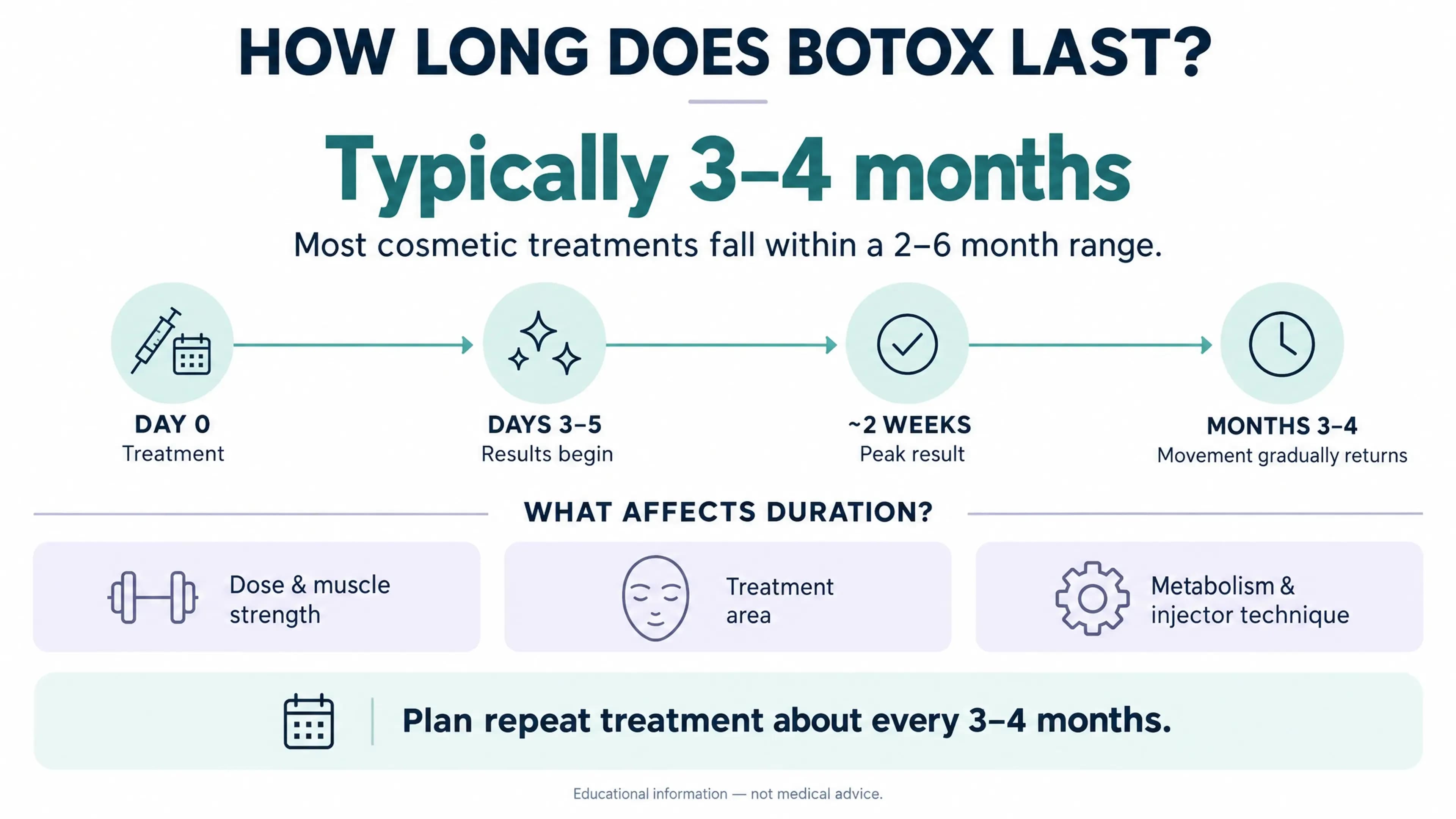
Botox typically lasts about three to four months for most cosmetic treatments, with a normal range of roughly two to six months. Duration depends on the dose, the muscle treated, your metabolism, and injector technique. High-movement areas fade soonest, and most people repeat treatment every three to four months.
- Botox lasts about three to four months on average for cosmetic use, with a normal range of roughly two to six months.
- Results appear in three to five days and peak at about two weeks; wait fourteen days before judging the outcome.
- Duration varies with dose, muscle strength, metabolism, treatment area, and injector technique; high-movement areas fade soonest.
- Results often last longer with consistent, well-timed treatments as the muscle weakens with reduced use.
- Stopping Botox does not worsen wrinkles or age you faster; muscles simply return to their natural baseline.
- Daxxify can last longer (often around six months); most other brands are similar at three to four months.
Botox is temporary by design, and understanding its timeline helps you plan treatments, budget realistically, and judge whether your results are normal. For most people a cosmetic dose softens lines for about three to four months before muscle movement gradually returns, though the honest answer is a range rather than a fixed number. This guide walks through how Botox works, the full onset-to-wear-off timeline, the specific factors that lengthen or shorten your results, how duration shifts by treatment area and brand, and how to protect and maintain your outcome. It closes with the safety limits worth knowing before you book.
FDA status: Botox (onabotulinumtoxinA) is FDA-approved for several cosmetic and medical uses, including frown lines, crow's feet, and forehead lines. Some popular aesthetic uses, such as masseter (jaw) slimming and the lip flip, are off-label, meaning the treatment itself is FDA-approved but that specific placement is not. Duration figures below reflect published clinical sources and typical ranges, not a guarantee for any individual.
Why Botox is temporary: how it works
Botox is a purified form of botulinum toxin type A, a neuromodulator that temporarily blocks the chemical signal (acetylcholine) that nerves use to tell a muscle to contract. When a small, targeted dose is injected into a specific facial muscle, that muscle relaxes, so the repeated creasing that forms dynamic wrinkles (frown lines, crow's feet, forehead lines) softens. Botox does not fill or plump anything and it does not dissolve existing deep static lines the way a filler can; it simply quiets the movement that drives wrinkle formation.
The effect fades for a predictable biological reason. Over the following weeks and months your nerve endings sprout new connections and regenerate the ability to signal the muscle, so movement gradually returns and lines reappear. Nothing is being permanently removed or destroyed, which is why the treatment is reversible and why it needs repeating. It is also why stopping Botox does not make wrinkles worse or age you faster: when the toxin wears off, your muscles simply return to their natural baseline, the same place they would have been without treatment, not to a worse state.
The Botox timeline: onset, peak, and gradual wear-off
Botox does not work instantly, and knowing the sequence prevents unnecessary worry. For the first day or two you typically see little change, because the toxin needs time to bind at the nerve-muscle junction. Most people notice softening around day three to five, with the effect building steadily from there. The full, peak result usually settles by about two weeks, which is why reputable injectors ask you to wait fourteen days before judging your outcome or requesting a touch-up.
From that two-week peak, results hold relatively steady for roughly the next few months. Wear-off is gradual rather than sudden: movement creeps back a little at a time, and lines slowly become visible again as the muscle regains strength. For a typical cosmetic dose in the upper face, the practical window from treatment to noticeable return of movement is about three to four months. If you have an important event, the planning rule is simple: book two to four weeks ahead so the result is fully developed and any minor bruising has resolved. A first treatment sometimes appears to fade a little sooner than later sessions, partly because injectors often start conservatively and build to your ideal dose over time.
What affects how long your results last
Duration is individual, and several overlapping factors explain why two people treated the same day can see different timelines. Understanding them helps you set realistic expectations and troubleshoot with your injector rather than blaming the product.
Metabolism: people with faster metabolisms tend to break down and clear the toxin more quickly, so highly active people and dedicated athletes often report shorter duration. Muscle strength and size: stronger, bulkier muscles regain movement sooner and frequently need a higher dose to achieve and hold the same relaxation, which is common in the jaw and forehead. Dose: this is one of the biggest levers. Smaller, softer, preventative or natural-look dosing wears off faster by design, while a fuller corrective dose generally lasts longer. Treatment area: high-movement zones fade soonest because the muscle is constantly working. Injector technique: accurate placement and appropriate dosing directly influence both how good and how durable the result is. Lifestyle factors: intense endurance exercise, heavy sun exposure, smoking, and high stress are commonly associated with shorter-lasting results, though the evidence for each varies. Finally, cumulative treatment history matters: with consistent, well-timed sessions, treated muscles weaken with reduced use, so many long-term patients find they need less product over time to hold the same effect.
How long Botox lasts by treatment area
Because movement is what drives wear-off, duration shifts noticeably depending on where the toxin is placed. Thin, constantly moving muscles around the eyes and mouth tend to recover fastest, while larger or less mobile muscles, and non-cosmetic uses such as sweat-gland treatment, often hold longer. The table below gives typical ranges reported across clinical and specialist sources; treat them as planning guides, not promises, because your own dose and anatomy set the real number.
Two off-label uses are worth flagging plainly. Masseter treatment (for jaw slimming or TMJ-related clenching) and the lip flip both use FDA-approved Botox but are not FDA-approved for those specific placements. The masseter is a large, powerful muscle, so results there often last on the longer end, whereas the lip flip uses a tiny dose in a highly mobile area and typically fades within a couple of months. Hyperhidrosis (excess sweating) is an FDA-approved medical use of Botox and frequently lasts substantially longer than facial wrinkle treatment.
| Treatment area | Typical duration | Notes |
|---|---|---|
| Forehead lines | 3 to 4 months | High movement, fades on the shorter side |
| Frown lines (the 11s) | 3 to 4 months | FDA-approved cosmetic use |
| Crow's feet | 3 to 4 months | FDA-approved cosmetic use |
| Masseter (jaw slimming / TMJ) | 4 to 6 months | Off-label, large muscle, longer duration |
| Underarms (hyperhidrosis) | 4 to 12 months | FDA-approved medical use, often longest |
| Lip flip | 6 to 10 weeks | Off-label, tiny dose, fades soonest |
Duration by brand: Botox, Dysport, Xeomin, Jeuveau, and Daxxify
All of the major botulinum toxin type A brands work by the same mechanism, and for most people their duration is broadly similar, in the three to four month range for facial wrinkles. The meaningful differences are usually in onset speed and, in one case, longevity. Dysport and Jeuveau are often reported to kick in a day or two faster than Botox, and Dysport can spread slightly more, which some injectors use strategically for larger areas like the forehead. Xeomin is a purer formulation without the accessory proteins found in some products, which is sometimes discussed in relation to a lower theoretical chance of the body developing resistance, though for typical cosmetic use the practical duration is comparable.
Daxxify (daxibotulinumtoxinA) is the notable outlier on longevity. It is formulated with a stabilizing peptide and, in manufacturer trials, has been reported to last longer than the other toxins, with results commonly cited in the six-month range for many patients, though real-world duration varies and not everyone achieves the maximum. Brand choice is a conversation to have with your injector based on your anatomy, goals, and budget rather than a decision to make on longevity claims alone.
| Brand | Typical duration | Onset |
|---|---|---|
| Botox | 3 to 4 months | 3 to 5 days |
| Dysport | 3 to 4 months | 2 to 3 days (faster) |
| Xeomin | 3 to 4 months | 3 to 5 days |
| Jeuveau | 3 to 4 months | 2 to 3 days |
| Daxxify | up to about 6 months (longest) | 1 to 3 days |
How to make your Botox results last longer
There is no proven trick that dramatically extends a single treatment, but a handful of evidence-supported habits genuinely help you get the most from each session. The single most effective strategy is consistency: rebooking on a schedule, before movement has fully returned, keeps the muscle continually under-used, so results tend to improve and last longer over successive treatments. Skipping long gaps lets the muscle fully rebuild strength each time and resets that progress.
The second lever is the treatment itself. An experienced, well-credentialed injector who places the toxin accurately and uses an adequate dose for your muscle will give you both a better and a more durable result than an under-dosed or poorly placed treatment. Follow standard aftercare in the first day to protect placement, and protect your skin longer term with daily sunscreen and a healthy lifestyle, since sun damage and smoking work against your overall results. Be skeptical of supplements, zinc protocols, special creams, or social-media hacks marketed to make Botox last longer; the evidence for them is weak to nonexistent, and the reliable path is good dosing, good technique, and a sensible maintenance rhythm.
Aftercare: protecting your results in the first 24 hours
Good aftercare will not extend your result for months, but poor aftercare in the first few hours can theoretically let the toxin migrate to unintended muscles, which risks side effects rather than better longevity. For roughly the first four to twenty-four hours, most injectors advise a short list of common-sense precautions, and this is largely what people mean when they ask what is forbidden after Botox.
Avoid rubbing, massaging, or applying firm pressure to the treated area, since manipulation can move product away from where it was carefully placed. Skip strenuous exercise, heavy exertion, and anything that dramatically raises blood flow to the face for about twenty-four hours, because it may increase bruising and swelling. Stay upright and avoid lying flat or bending over for several hours after treatment. Hold off on facials, saunas, hot tubs, and intense heat for a day or two. Alcohol and blood-thinning medications or supplements can increase bruising, so many injectors suggest avoiding alcohol on the day of treatment. Gentle facial expressions are fine and do not harm the result. If your provider gives you specific instructions, follow theirs over any general list, since aftercare can be tailored to your treatment.
Signs your Botox is wearing off and building a maintenance schedule
Because wear-off is gradual, the earliest sign is usually the subtle return of movement in the treated muscle rather than the sudden reappearance of a deep line. You might notice you can raise your brows a little more, that your frown starts to crease when you concentrate, or that fine lines you had not seen in months begin to reappear. This return to your natural baseline is expected and is not a sign that Botox damaged your skin or made anything worse; it is simply the treatment fading.
Most people settle into a maintenance rhythm of a repeat treatment roughly every three to four months, which is where the popular rule of thumb of about three months comes from. Some patients, particularly those on larger doses, treating slower-moving areas, or several treatment cycles in, comfortably stretch to four to six months. The practical approach is to rebook when you first notice meaningful movement returning rather than waiting until lines are fully back, because treating from a partially maintained baseline is what produces the smoother, longer-lasting results seen with consistent, well-timed sessions. If your results consistently fade in under two months, that is worth raising with your injector, as it may point to under-dosing, strong musculature, or timing rather than a defective product.
Safety, side effects, and honest limits
Botox has a long track record and, in trained hands, a strong safety profile, but it is a prescription medical treatment with real trade-offs worth weighing. The most common side effects are mild and temporary: injection-site bruising, redness, swelling, and headache in the days after treatment. Less commonly, if the toxin spreads or is mis-placed, you can get a temporarily drooping eyelid or brow, an asymmetric or heavy look, or an unnatural, over-frozen expression; these are usually not permanent and resolve as the effect wears off over weeks. Serious complications are rare in cosmetic use but the labeling carries a warning about the toxin spreading beyond the treatment area, which can rarely cause swallowing or breathing difficulty, so any such symptoms warrant prompt medical attention.
Botox is not right for everyone. It is generally avoided during pregnancy and breastfeeding, in people with certain neuromuscular disorders, and where there is an allergy to ingredients, so an honest medical history matters. The clearest limitation is simply that it is temporary: results recur only with repeat treatment, so the cost repeats too. Pricing is typically charged per unit or per treatment area and varies widely by provider, region, brand, and how many units you need, so a specific dollar figure is impossible to promise here. For context on longevity questions people often pair with this: dermal fillers, which do a different job, generally last longer than Botox (often many months to a couple of years depending on the product), but the two are not interchangeable. Because your outcome depends heavily on who treats you, the most important decision is choosing a qualified, appropriately licensed injector.
Frequently asked questions
What is the rule of 3 in Botox?
It is a memory aid, not a clinical standard: Botox roughly starts working in about three days and lasts about three months, so many injectors schedule repeat treatment around every three months. Individual timelines vary, so use it as a rough mental model rather than a guarantee.
What happens after 10 years of Botox?
With consistent, appropriately dosed treatment, regularly treated muscles stay trained smaller and weaker, so many people need less product over time for the same effect. There is no evidence that correctly dosed Botox causes long-term harm over a decade, and stopping simply lets muscle movement return to baseline over a few months.
Do you age faster after stopping Botox?
No. When Botox wears off, treated muscles return to their natural baseline, the same place they would have been without treatment, not to a worse state. Lines you previously softened will gradually reappear, but Botox does not accelerate aging or make wrinkles deeper than they otherwise would have become.
Which lasts longer, Botox or fillers?
Fillers generally last longer than Botox, often many months to a couple of years depending on the product and area, while Botox typically lasts three to four months. They are not interchangeable, though: Botox relaxes muscle movement, while fillers add volume, so the right choice depends on the concern being treated.
Can Botox last six months?
For some people, yes, particularly with larger corrective doses, less mobile or FDA-approved medical areas like underarm sweating, or longer-lasting products such as Daxxify. Six months is toward the upper end of the normal range for facial wrinkles, so treat it as possible rather than typical.
- 1.BOTOX Cosmetic (onabotulinumtoxinA) Prescribing Information (2021) — U.S. Food and Drug Administration (accessdata.fda.gov)
- 2.Botox (Botulinum Toxin): What it is, Results & Side Effects — Cleveland Clinic
- 3.Botulinum Toxin — American Society of Plastic Surgeons (plasticsurgery.org)
- 4.How Long Does Botox Last? — Healthline (medically reviewed)
- 5.Botox: How long it lasts and other considerations — Medical News Today
- 6.Botulinum toxin (Botox) A for reducing the appearance of facial wrinkles: a literature review of clinical use and pharmacological aspect — PMC (Journal of Cosmetic Dermatology review)
- 7.A Systematic Review and Comparative Analysis of Botox Treatment in Aesthetic and Therapeutic Applications — PMC (systematic review)