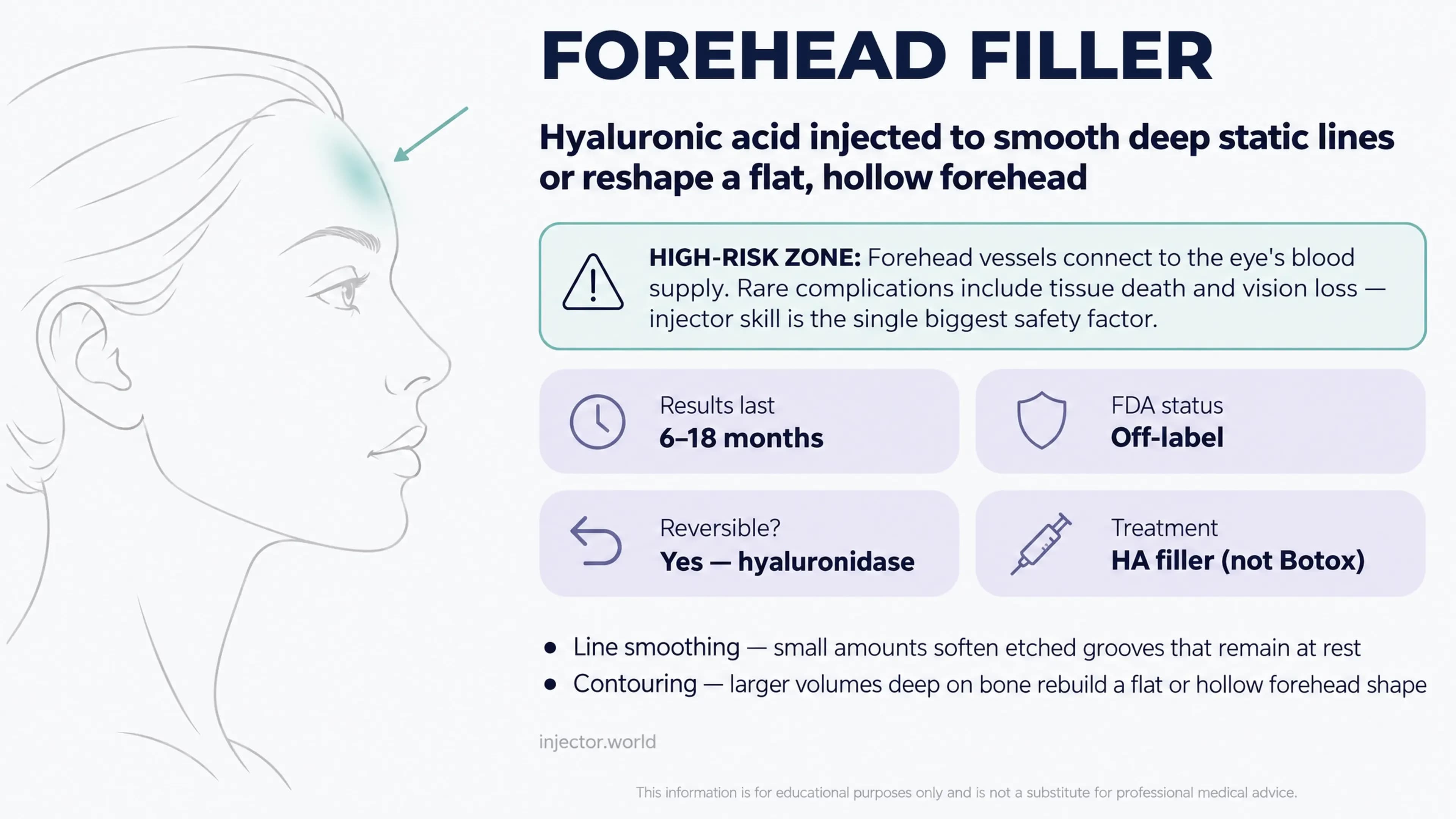
Forehead filler uses injectable dermal filler, usually hyaluronic acid, to smooth deep static lines and restore volume or contour to a flat or hollow forehead. Most placements are off-label, and the forehead and glabella rank among the highest-risk filler zones, so injector skill is critical.
- Forehead filler uses injectable dermal filler, usually hyaluronic acid, to smooth static lines or reshape a flat, hollow forehead. It is not the same as Botox, which relaxes movement lines.
- Injecting filler into the forehead is generally off-label; dermal fillers are FDA-approved for areas such as cheeks, lips, chin, jawline, and hands, not the forehead specifically.
- The forehead and glabella are among the highest-risk facial zones for filler because vessels there connect to the eye's blood supply; rare complications include tissue death, blindness, and stroke.
- Hyaluronic acid results typically last about 6 to 18 months and are reversible with hyaluronidase if a problem or a disliked result occurs.
- Injector skill is the single biggest safety factor. Choose an experienced provider who keeps hyaluronidase on hand, not the cheapest option.
Forehead filler is one of the most misunderstood treatments in aesthetic medicine, partly because two very different procedures share the name. Some people mean softening the deep horizontal lines that remain visible when the face is completely at rest. Others mean reshaping a flat, sloping, or hollow forehead to improve its curve and its balance with the brow, temples, and midface. Both use injectable dermal filler, but they call for different products, injection planes, and levels of injector experience. This guide explains what forehead filler actually does, who it suits, how it is performed, how it compares with Botox and surgical options, what it costs, and why the forehead is treated as advanced, higher-risk territory.
FDA status, stated plainly: dermal fillers are FDA-approved for specific facial areas such as the cheeks, lips, nasolabial folds, chin, jawline, temples, and the back of the hands. Injecting filler into the forehead itself is generally off-label, meaning the FDA has not cleared a filler specifically for that region. Off-label is legal and common in experienced hands, but the forehead and the glabella between the brows carry genuine vascular risk, so provider selection matters more here than almost anywhere on the face. This guide is educational and not a substitute for individual medical advice.
What forehead filler is
Forehead filler is a non-surgical injectable treatment that places dermal filler beneath the skin of the forehead to smooth lines, add volume, or refine shape. The material used is almost always a hyaluronic acid (HA) gel, the same reversible product class used in cheeks and lips, though thinner, more spreadable HA formulations are typically chosen for the forehead because the skin here is close to the bone and shows lumps easily. Hyaluronic acid is a sugar molecule that occurs naturally in skin, and HA fillers work by binding water and holding a soft cushion of volume where they are placed.
It helps to separate two goals. The first is smoothing static horizontal lines and glabellar frown lines that persist at rest, where small amounts of filler soften the etched crease. The second, more specialized goal is contouring: rebuilding a flat, receding, or irregular forehead into a smoother, gently convex shape that catches light evenly. Contouring uses larger volumes placed deep against the bone and is a distinctly advanced procedure. Understanding which version you actually want, and which one a given injector is offering, is the first step to a realistic and safe result.
How forehead filler works
Filler and Botox address forehead concerns in opposite ways, and confusing them is a common mistake. Botox and other neuromodulators relax the muscles that crease the skin, which is why botulinum toxin type A is FDA-approved for forehead lines and glabellar frown lines. Filler does not touch muscle activity. Instead it physically fills or lifts, adding structural volume under a line or across a hollow so the surface sits smoother. That difference explains why filler suits lines that are still visible when your face is relaxed, while Botox suits lines that appear only when you raise your brows or frown.
Placement depth is what makes the forehead technical. For fine surface lines, a very small amount of thin HA may be feathered into the superficial dermis. For contouring a flat forehead, filler is deposited in a deep plane directly on the periosteum, the layer covering the bone, where it can rebuild projection without showing as bumps. Between those planes runs a network of arteries, including the supratrochlear and supraorbital vessels, which is why injectors work slowly, in tiny aliquots, often with a blunt cannula rather than a sharp needle, and aspirate or move continuously to reduce the chance of entering a vessel.
Who is a good candidate
Good candidates are healthy adults with realistic goals who understand that forehead filler is off-label and technique-dependent. The clearest candidates for line smoothing are people whose horizontal forehead lines or frown lines remain visible at rest and who have already found that Botox alone flattens the movement but leaves an etched groove. In those cases a conservative amount of filler can refine what the neuromodulator cannot. Candidates for contouring are people with a genuinely flat, sloping, or hollow forehead who want a smoother, more balanced profile, a request that is common among patients seeking a softer or more feminine brow-to-hairline curve.
Some people are better served by an alternative or by no treatment at all. Very thin skin, prior filler complications, or a history of vascular events raise the risk profile. Fillers are not recommended during pregnancy or breastfeeding, and active skin infection in the area should be treated first. People prone to keloids, certain autoimmune conditions, or bleeding disorders need individualized assessment. A responsible injector screens candidacy honestly, and will sometimes recommend Botox, resurfacing, fat transfer, or a surgical consult instead of filler when those options fit the anatomy better. Being told you are not a candidate is a sign of good judgment, not a lost sale.
What the procedure involves
A forehead filler session usually takes 20 to 45 minutes. It begins with a consultation in which the injector maps your lines and contours, checks your history, and agrees on a plan and product. The skin is cleansed thoroughly, since infection control matters more when filler sits near bone, and a topical numbing cream or filler pre-mixed with lidocaine is commonly used for comfort. Many experienced injectors treat the forehead with a blunt-tipped cannula introduced through one or two entry points, because a cannula pushes vessels aside rather than piercing them and can cover a broad area from a single access point.
Filler is then deposited in small, controlled amounts in the chosen plane, deep on the bone for contouring or more superficially for fine lines, with the injector pausing frequently to mold the gel and reassess symmetry in a mirror. Total volume varies widely, from a fraction of a syringe for lines to several syringes across sessions for full contouring, and cautious injectors often stage larger corrections across visits rather than overfilling in one sitting. Afterward you may have mild swelling, redness, or small bruises that settle over days. You will usually be told to avoid heavy exercise, alcohol, and heat for a day or two, and to report any unusual pain, blanching, or vision change immediately.
Results and how long forehead filler lasts
Results are visible immediately, which is one of the appeals of filler over treatments that take weeks. You will see smoother lines or a fuller contour on the table, though the true result appears after initial swelling resolves over one to two weeks. Because hyaluronic acid binds water, a small amount of settling and softening is normal in the first days, and a good injector plans for this rather than overcorrecting.
How long forehead filler lasts depends on the product, the amount, the plane, and your metabolism. As a general guide, hyaluronic acid results in the forehead commonly last somewhere between about 6 and 18 months, with deeper structural placement on bone tending to persist longer than fine superficial work, and thinner spreadable gels often fading sooner. Movement-heavy areas can metabolize filler faster. These are typical ranges reported in clinical practice, not guarantees, and individual longevity varies. A meaningful advantage of HA filler is reversibility: if you dislike the result, develop lumps, or have a complication, an injector can dissolve the gel with the enzyme hyaluronidase, an option that non-HA fillers such as calcium hydroxylapatite or poly-L-lactic acid do not offer.
Risks and safety: why the forehead is high-risk
Most forehead filler side effects are mild and short-lived: swelling, redness, tenderness, small bruises, and occasional lumps that can be massaged or dissolved. The reason the forehead demands special caution is a rarer but far more serious category of harm. According to the FDA, the most concerning risk of any dermal filler is unintentional injection into a blood vessel, which, although uncommon, can cause tissue death, and in the worst cases permanent vision loss or stroke. The forehead and the glabella between the eyebrows are widely regarded as among the highest-risk zones on the entire face for exactly this reason.
The anatomy explains it. The supratrochlear and supraorbital arteries in the forehead and glabella connect, through the orbit, to the ophthalmic artery that supplies the eye. If filler is forced into one of these vessels under pressure, it can travel backward and block retinal blood flow, causing sudden, often irreversible blindness. Published reviews of periorbital and forehead injection catalog vascular occlusion, skin necrosis, and visual compromise as recognized, if infrequent, complications. This is precisely why the treatment should be performed only by a highly experienced injector who knows the vascular map, uses slow low-pressure technique and often a cannula, keeps hyaluronidase on hand, and can recognize and act on the early warning signs, severe pain, skin blanching, mottling, or any change in vision, within minutes. Choosing your injector is not a detail here. It is the single largest factor separating a good outcome from a catastrophic one.
Forehead filler compared with the alternatives
Forehead filler is one option among several, and the right choice depends on whether your concern is movement lines, static lines, volume, or shape. Botox remains the first-line, FDA-approved treatment for dynamic forehead and frown lines and is lower risk in this region. Filler is added when static grooves or contour deficits remain. For dramatic reshaping, surgical options such as forehead or brow contouring, or fat transfer, offer permanence that filler cannot, at the cost of downtime and irreversibility.
| Option | Best for | Longevity | Reversible | FDA status in forehead |
|---|---|---|---|---|
| Hyaluronic acid filler | Static lines, contour, hollows | About 6 to 18 months | Yes, via hyaluronidase | Off-label |
| Botox (botulinum toxin type A) | Dynamic movement lines | About 3 to 4 months | No, wears off | FDA-approved for forehead and glabellar lines |
| Fat transfer | Larger volume, natural filler | Variable, semi-permanent | Partially | Surgical procedure |
| Forehead or brow surgery | Bone or structural reshaping | Permanent | No | Surgical procedure |
In practice, filler and Botox are frequently combined: Botox calms the muscle so lines do not re-etch, while a small amount of filler smooths what remains. Discuss which combination fits your anatomy, and be wary of any plan that pushes large forehead filler volumes as a first move.
What forehead filler costs and whether it is worth it
Forehead filler is usually priced per syringe of hyaluronic acid, and pricing varies widely by city, injector credentials, product brand, and how much material is needed. Rather than trust any single quoted figure, expect line smoothing to require less product and a full forehead contour to require more, sometimes several syringes staged across visits, which raises the total accordingly. Because reputable clinics price transparently per syringe and per session, ask for a written estimate that states the product, the number of syringes, and whether touch-ups are included. Injectables are cosmetic and not covered by insurance.
Whether it is worth it is a personal calculation, and an honest answer is that it depends on the goal and the injector. For the right candidate, a conservative treatment by an expert can deliver a natural, immediate, and reversible improvement, which many people value highly. But the forehead offers a worse risk-to-reward balance than lower-risk areas like the cheeks, so the value equation hinges on finding a genuinely skilled injector rather than the cheapest price. Bargain-hunting on forehead filler is a false economy, because the money you save on an inexperienced injector is exactly the money that buys safety in a region where the rare complications are severe. If a truly expert provider is out of reach, Botox alone or waiting is often the wiser choice.
How to choose a qualified injector
Because the forehead is off-label, higher-risk anatomy, the provider you choose is the treatment's most important variable. Look for a licensed physician, physician associate, nurse practitioner, or registered nurse with specific, documented experience injecting the forehead and glabella, not just lips and cheeks. Ask directly how many forehead cases they perform, what plane and instrument they use, whether they keep hyaluronidase on site, and how they would manage a vascular occlusion. A confident, specific answer is a good sign; vagueness or dismissiveness is a reason to leave.
Review before-and-after photos of their own forehead patients, confirm they inject FDA-approved hyaluronic acid products rather than unbranded or unknown material, and expect a real consultation that discusses risks in plain language and screens your candidacy. Trustworthy injectors will sometimes tell you that filler is not the best answer for your forehead, and will explain why. When you are ready to compare qualified, verified injectors near you, use the provider hand-off below to find a match for forehead line and contour treatment.
Frequently asked questions
Can you get filler in your forehead?
Yes, dermal filler can be injected into the forehead to smooth deep static lines or reshape a flat or hollow contour, but it is an off-label, advanced placement. Because forehead vessels connect to the eye's blood supply, it should only be done by a very experienced injector using careful, low-pressure technique.
How much does forehead filler usually cost?
Forehead filler is typically priced per syringe of hyaluronic acid, and cost varies widely by city, injector experience, product, and how much is needed. Line smoothing uses less product than full contouring, which can require several syringes across visits. Ask for a written per-syringe estimate; injectables are cosmetic and not covered by insurance.
How long do fillers last in the forehead?
Hyaluronic acid filler in the forehead commonly lasts about 6 to 18 months, though this is a typical range and not a guarantee. Deeper structural placement on bone tends to last longer than fine superficial work, while thinner gels and movement can shorten it. Individual longevity varies with product, amount, and metabolism.
What are the riskiest areas for filler?
The glabella between the brows, the forehead, the nose, and the under-eye area are widely considered the highest-risk zones. Their arteries connect to the eye's blood supply, so accidental injection into a vessel can, rarely, cause tissue death or permanent blindness. These areas demand an expert injector and extra caution.
Is forehead filler worth it?
For the right candidate treated by a genuinely expert injector, forehead filler can give a natural, immediate, reversible improvement. But the forehead has a worse risk-to-reward balance than lower-risk areas, so its value depends heavily on injector skill. If an expert is out of reach, Botox alone or waiting is often wiser.
- 1.Dermal Fillers (Soft Tissue Fillers) — U.S. Food and Drug Administration
- 2.FDA-Approved Dermal Fillers — U.S. Food and Drug Administration
- 3.Periorbital Injectables: Understanding and Avoiding Complications — PMC / U.S. National Library of Medicine
- 4.Dermal Fillers — American Society for Dermatologic Surgery (ASDS)
- 5.Dermal Fillers — American Society of Plastic Surgeons (ASPS)
- 6.Facial fillers for wrinkles — Mayo Clinic